Showing posts with label drama. Show all posts

30.8.09

Cadillac Records


Verbatim from my short Netflix review (except for a change from a 5 star scale to my 4 star one here):

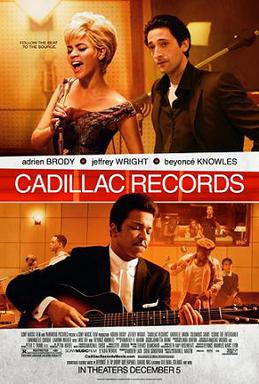
The history of Chicago blues deserves an amazing movie -- Muddy Waters, Etta James, Little Walter, Chuck Berry, Howling Wolf, and many others who aren't even mentioned in this movie led the dramatic lives that only bluesmen seem to live, and at the same time changed music, Chicago, and race relations forever.

Unfortunately this movie isn't amazing. It's entertaining enough, and the star-studded cast all have incredible talent, both in acting and in making music (which all the actors do on screen rather than dubbing it in). But the script tries to cram too much in at a time and ends up failing to do justice to these men and women's lives. This movie is too scattershot, with too many characters in the ensemble given too little screen time to explain their presence. If you don't already know who Howling Wolf is, for example, this movie won't really tell you. If you don't already know of him, his character is like an inside reference that you just don't get. At the same time, the movie is too generalized and too historically inaccurate to satisfy real blues fans. And if you know the songs being sung, they are off by just enough to drive you crazy (especially, for me, the Etta James songs, no matter how talented Beyonce is).

I was so ready to adore this movie, because I adore Chicago Blues. Instead, all I can say is that it inspired me to listen to my old CDs with Etta James, Howling Wolf, Muddy Waters, and all the rest, and made me want to read a real biography of the Chess family. That's enough to warrant a very solid two stars, but I'm so sad I can't give it more.

29.7.09

Dexter: Just Blood


Showtime’s dark drama Dexter (don’t blame me for the alliteration – after all, the show is based on a book called “Darkly Dreaming Dexter”) is about a forensics expert who’s also a serial killer. But wait! He’s a moral serial killer who only kills bad guys, so he still qualifies to be the center of a whole television show.

I had heard this line explaining Dexter so many times from people saying the show was excellent over the last couple years, and frankly I was a bit turned off by this summary of the premise. A serial killer anti-hero seems like such a gimmick: we’ve seen anti-heroes abound in critically acclaimed television recently – think Dr. House, Tony Soprano, Malcolm Reynolds (from Firefly), and even Jack Bauer breaking all those laws. A gimmicky serial killer show doesn’t interest me much as a concept. Who needs another crime drama? And serial killers are so Other that they’re not that psychologically interesting to me, unlike those other anti-heroes.

But I finally caved – partly because Dexter is on Instant Watch on Netflix and mostly because my sister started watching it. My sister being intrigued by a show is a good indicator that I will be, too, whether I initially like to admit it or not (see, e.g., Firefly & Doctor Who). So I watched the first episode, and then the whole first season.

Dexter, as both a show and a character, troubles me. They trouble me so much that this is a snapshot from my computer camera as I watched the second episode:


This show certainly trades in its share of blood and gore, and those who like that part of crime shows (or, say, liked the Angel of Death scene in Silence of the Lambs) will be satiated. I, on the other hand, don’t particularly like it. I’m either creeped out, or – more likely – disappointingly unmoved by fake gore because I keep thinking, “Hmm, I wonder what the techs used to mix that blood.” The sneer of disgust in the above snapshot isn’t me being grossed out by a murder scene, actually. It’s me watching the credits and thinking about the show in general. And yet I watched it, because I kept clinging to the theory that this show is more than it seems. I still think so, even though I’m not totally convinced.

(By the way, I also don’t find the show that funny, as many people on Netflix say. Yes, the sister has her moments and Dexter has some pretty dry jokes, but this isn’t a dramedy or a macabre black comedy about a serial killer (which has been done to perfection in Keeping Mum, a delightful movie I highly recommend). It’s a cruel little show that keeps your attention with a weird twist on the anti-hero trope and a bunch of blood.)

On the one hand, Dexter as a main character seems like a clever ruse by an inept writer who was tired of hearing that his characters weren’t lifelike or human enough. Creating a “loveable monster,” which is how Dexter is billed on the books and the DVD blurb, seems an easy out. A guy who has no human emotion is supposed to be an unconvincing character, right? This is no offense to the author Jeff Linsday. I haven’t actually read the books so I don’t know if they’re any good. But it certainly seems like a cop out.

The show also seems to cop out with respect to the larger themes it engages. Other shows about unlikable characters grapple with mortality, morality, and religion by creating equally articulate but oppositely opinioned supporting characters (one of the reasons I like House so much). Dexter, on the other hand, just starts from the premise that some people deserve to die; the only grappling comes with the question, “Yeah, but does that mean it’s OK for a serial killer to kill them?”

By creating a non-human main character – less human even than anthropomorphized animals and aliens in other shows – Dexter is no longer a human we have to condone or condemn. Instead he becomes a symbol of rightful anger and bloody justice. He is an outlet for viewers, who believe in the death penalty in overwhelming numbers, who hear about killers going free on legal technicalities (and who may remember O.J. Simpson), who live vicariously through the righteous vengeance of television characters. But vengeance isn’t ours, even in made-up books and television, and I find myself extremely reluctant to relate to Dexter or “root” for him as so many fans claim to do. The show ultimately rests the likeability of its main characters in an assumption about the inner cruelty of the viewers, and this conceit is what disturbs me the most about the series. That the show is popular seems to indicate that many people agree with this conceit, which is what disturbs me the most about the viewers of this show.

On the other hand, maybe the show and its viewers are more nuanced than that. The plots and overall arc of the first season are compelling and downright good storytelling. The multi-episode arc involving another mysterious serial killer is good (and I don't want to spoil it), even if parts of it are pretty predictable (as in, I figured out who it was the first scene he/she was in, even though there was no positive identification for several more episodes.) The actors are good, too, and some of the side stories of intra-office politics are delightfully raw and nuanced. Many of the side characters inspire empathy as well, such as a painfully honest cop who is separated from his wife because he told her about the one time he cheated on her.

Better still, even though the show revolves around a character who describes himself as neither human nor monster, Dexter does become slightly more human throughout the first series, once the premise is firmly established that he’s not. This might be because it’s impossible to create an interesting character with no emotions, but I like to think that the show is trying to break down what we think it means to be human.

If you look at it this way, the show raises questions it never discusses. In a way, this is more skillful than the shows I love (like House) that hit you with a Big Issue 2x4 whenever an interesting ethical or philosophical tension arises. And the questions raised by Dexter are both important and complex: If we fake intimacy, is it still intimate? What are the limits of anti-Kantian ethics in terms of preventing harm to others? Do we feel more compassion for Dexter because he’s a foster child with hints at a horrible past, and if we do, why? Can we really mitigate the evil of serial killing by saying, “Oh, but you had a bad childhood”? And that raises the question of the whole premise: can we really mitigate the evil of serial killing by saying, “Oh, but you killed the bad guys, at least”? Why is Dexter the serial killer our hero, but Ice Truck Killer the serial killer our villain, when they are so clearly linked? Ultimately, how can we say someone is irreversibly good or bad? And what do we do about it if we can make such a determination?

That a television show can raise so many questions, especially about what it reveals about the people who watch and like the show and the main character, reveals some hidden mastery. I’d like to think so, at least. And so who am I to judge my fellow viewers who may be thinking on this level, too, rather than simply using Dexter as an outlet for bloody justice or merely blood?

So, even though I started with that grimace, I did end up entertained by some good storytelling and intrigued by some interesting questions. All in all, 3 stars.

22.6.08

Spartacus: mini-review

OK, I've got lots of work still to do this weekend, but something's better than nothing, right? Here's my review from Netflix:

Spartacus is NOT your typical Kubrick in terms of lasting takeaway message -- the nihilism and despair that linger in Clockwork Orange, 2001, and Dr. Strangelove just don't exist here. It is, however, typical Kubrick insofar as it is masterful. There is not an actor in this film that I did not admire more after watching Spartacus -- they all give amazing performances, which is pretty easy, I suppose, if you have such amazing material. This would be worth a spot in your queue just to watch the famous "I am Spartacus!" scene, but it's really oh so much more. It's got layers and layers here, with certain parts of the characters' lives (I'm thinking especially Tony Curtis here) obfuscated because of the Censor Board. But that only makes it better -- you have to actually be thinking and caring about these characters to understand why they do what they do. And it's well worth the effort.

28.4.08

Smart People


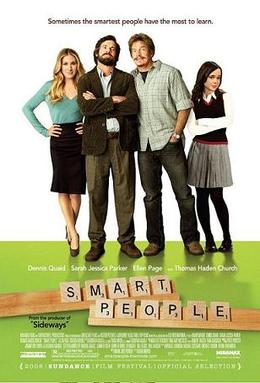
Smart People fits into the mass-audience pseudo-indie film category that some of the most popular movies of the past few years (Juno, Napoleon Dynamite) come from. But with over-exposure comes being over-done. This is a passably enjoyable film, exhibiting both the best and the worst of the genre.
On one hand, all the actors (except SJP, who mostly just looks like she's mixing Family Stone with SATC and hoping that'll pass as acting) inhabit their characters incredibly, revealing their fear and vulnerability under the hard exteriors that come with being "smart" and "successful." I really loved the poignancy of Ellen Page's character -- a high school girl whose desire to live up to her father has sapped her of her childhood. Dennis Quaid, as lonely, over-compensating misanthropic professor, is also amazing.
Unfortunately, the great performing suffered from a script at times too obvious ("We're smart people; we'll figure it out" is a bit of a 2x4, no?) and direction too blatant (a brilliant bit with Thomas Haden Church's character posting signs on telephone poles is almost ruined by calling too much attention to the gag). And, the story has too many haphazard events unnecessary to the resolution of the film (I'm thinking mostly of the son's girlfriend, the recommendation letter, and the pregnancy).
In the end, though I enjoyed it, I wish the movie had lived up to its name and been a little more, well, smart.

2.5 stars.

17.4.08

Play Misty For Me


Clint Eastwood is my mother's favorite actor, and so, in honor of the approaching holiday in her honor, I watched Clint's directorial debut. (OK, well, I didn't really watch it for that reason, but I did watch it in large part because I grew up with my mother gushing over the man.) I must confess horror movies don't generally do it for me. With the exception of Hitchcock and his disciples, I can never really get into them. I don't particularly like gore -- it either grosses me out, or just as often looks way too fake for me to do anything other than stare at it with an amateur director/critic's eye and just be unimpressed. And the whole idea of being scared or "thrilled" rarely works differently -- the only movie that has come even close to freaking me out since I was 16 and started watching R rated movies was The Shining. Everything else just seems too contrived for me. It's so formulaic that there's no horror involved -- you know exactly who's going to die or get hurt and when, and that just takes all the fun out of it. It's not like romcom, where the formula supports the genre; horror is supposed to surprise and startle you, but if it's so obviously working off something as predictable as sewing patter, well, I'm not sold.

So maybe I'm not the best person to review this piece with a favorable eye, but while I thought the movie was decent, my main comment is that Play Misty For Me has become a period piece -- everything about it is steeped in the early 70s, which is fun to watch but even more distracting to the idea of a thriller. Even the suspense seems dated: a quaint idea based on the premise that someone would meet a woman, slowly realize she is suicidal and has psychotic episodes, and then proceed to do nothing about it until all sorts of havoc has been wreaked. However, if you can get over the things that date this movie, it's quite enjoyable: the actors are all young and passionate (I mean that in all senses of the word) and the plot makes for a simple vehicle for them to chew scenery and revel in 1970s California, which is shot quite beautifully (red woods, ocean, and cliffs abound). The direction is sometimes predictable (lots of shots that seem omniscient and then you realize they are point of view shots, for example), but it is worthy enough to foreshadow the much better work that Clint directed later, from Unforgiven to Mystic River to Million Dollar Baby.

1.4.08

The Aviator


Confession: I am not a Martin Scorsese fan. Raging Bull was fine, but I definitely wouldn't rate it as the fourth best American movie ever. But eventually the perpetual hype got to me, and I put The Aviator in my DVD player with great anticipation. A three-hour long movie (170 minutes, to be exact) that got rave reviews has to be riveting, right?

Unfortunately, the other option for a 170 minute movie is that it's overblown with its own importance. Granted, it fits well with the subject matter here -- it appears that Howard Hughes was a pretty self-important man -- but Mr. Scorsese seems to forget that a movie is still a movie no matter how long, and it would have been nice to feel like there was a reason for my watching rather than seeing a scattershot of events that happen to be roughly true.

For those of you who may have missed it, The Aviator outlines the life of Howard Hughes, the great filmmaker and aviator, from the late 1920s to the 1940s. (Howard Hughes produced Hell's Angels, Scarface, The Outlaw, and a slew of films noir in the '50s, and set multiple air-speed records during his lifetime.) I'm not quite sure why the timeframe of the movie was chosen -- after a brief prologue of a scene of Hughes as a child, it jumps straight to the production of Hell's Angels, which wasn't Hughes' first movie. And it stops after he successfully tests the Hercules, a huge aircraft that spent him years to make, but before he took control of RKO, or severed his relationship with his longtime assistant Noah Dietrich, or founded the Howard Hughes Medical Institute. Maybe this would make sense if we assume that everyone knows about Howard Hughes's story and his descent into madness in his later years, but let's not assume that a movie-going public that is mostly teenagers knows about a rich and crazy guy who died in the 70s.

As for the movie itself, the best part about the movie was that it was star-studded as Howard Hughes' apparently was: big names played bit parts for the chance to be in a Scorsese film, and it was fun to watch Gwen Stephani, Jude Law, Ian Holmes, Alan Alda, and a bunch of others in fairly small roles. Leonardo DiCaprio does a good job playing a part with almost no guidance from the script as to a story arc. Now, I know people's lives don't necessarily have climaxes and turning points and drama to their days, but if you're consolidating a life (or part of a life) to a few hours, you've got to have a reason for what you see and what you dont. Now, I don't mean that I need to know why Hughes went mad, for example, but hinting that it was a childhood thing but not exploring that just frustrated me, and to have character after character march in and out of his life isn't helpful to understanding his life. Similarly, Cate Blanchett does a passable job as Katharine Hepburn, but her role seemed more about imitation than acting -- the problem with playing a person that spent a lot of the time on film herself. In the end, I felt like the movie was less a story than an observation/impersonation, which seems a waste of time and talent to me. Even documentaries are supposed to be edited to have a direction to the story it tells, but this was just sprawling and pointless even though it was larger-than-life and impressive to watch. Maybe that was the point: that Howard Hughes' life was jam-packed with action, danger, risky business moves, Hollywood stars, and paranoia, but in the end didn't have much direction or purpose. But if that was the point, I'd rather read a biography that really explores the whole life and wonders why his life was both so amazing and so screwed up. Just watching some random, disparate parts of a man's life for three hours was about double the time I was willing to spend. Note to future Scorseses: Editing something to make it shorter generally makes it better, not worse.

2 stars

20.3.08

The Skulls

I went ahead and watched The Skulls, which I posted in its entirety just a couple entries ago. I had watched it a few times in high school as one of those trashy movies you put on in the background during a sleepover, so it brings back fond memories for me, even though I couldn't remember the plot at all. In fact, I could only remember two things about the movie before watching it: that at one point the main character says "Hell yes!" instead of "Hell yeah!" which was the topic of conversation during one of these sleepovers, and that there were a couple beautiful scenes, by which I mean the visuals (aka people) are beautiful, not that they are written beautifully or anything.

My review, then, is colored by the movie sending me back to high school, so please cut me some slack when I say I enjoyed it. It is the movie equivalent of one of those mystery/thriller novels you buy for summer reading: sleek, cleverly crafted and terribly fun, even if it's not "highbrow" fare. Joshua Jackson and Paul Walker are sexy and assured in their roles as two very different undergrads at Yale -- the working class boy and the rich legacy boy -- who both become members of a secret society. The working class boy (Jackson) is the main character, of course, and the one with the ethical convictions, of course, even if those convictions waiver for a while in the face of the riches and opportunity that come with being part of the elite Skulls. When his best friend dies while trying to write a newspaper story on secret societies, Working Class Boy calls on the help of Trusty Female Sidekick/Love Interest to help free him from the clutches of his new pal, Legacy Boy, and the rest of the powerful members of the Skulls. The plot is moderately well developed (even though it's trite and the end feels slapped together at best), and Leslie Bibb does a wonderful job as the only female role of any substance and the only character who seems to have normal human reactions -- like screaming in fear -- to the things going on around her. There are some fun lines and slick moves on the part of the main characters, even beyond that "Hell yes!" scene. So while there are very few interesting characters for a conspiracy-theory story, and while the characters sometimes become caricatures, and even while Paul Walker can't shake being too stiff at times, it's enjoyable enough to pull it out of being a complete mess.

2 Stars

6.6.07

The Pursuit of Happyness

I watched The Pursuit of Happyness on an airplane from Newark to Heathrow this week, so it was probably not exactly the best experience to evaluate the movie, especially as it was on for about an hour before they stopped it (the entertainment had started because we were stuck on the plane for many hours before we actually took off). So I kind of watched the movie in two parts, which definitely breaks the flow of the narrative.

That being said, I think this was an excellent, if slightly trite, movie. It’s pretty much your powerful Hollywood drama, complete with a big star and a cute kid. In the movie, Will Smith plays a man struggling to get by in San Francisco in the year 1981. He’s a salesman of some obscure medical device, which basically means his job is to constantly be rejected as he tries to sell all the devices he invested in. Then his wife leaves him, leaving him a broke and single dad to his four-year-old son, Christopher, played by Will Smith's real-life son Jaden. (That casting certainly makes the father-son bond convincing, a huge benefit for a movie that's main danger is becoming too schmaltzy.)

Enter your favorite “overcome adversity” soundtrack. Will Smith’s character, named Chris Smith, is only a high school graduate, but he's also something of a math whiz. To prove this point, there’s a few fun scenes involving the “latest hot new toy” – a Rubik’s cube, which is one of the few things that solidly grounds the story to a date. So Smith applies to a stock brokerage internship to try to work his way out of his shoestring lifestyle.

Oh yes. It’s an unpaid internship. So, he has to be a single parent, a salesman of an unsaleable product, AND an intern in a highly competitive program. And pretty quickly, make that a homeless single parent.

If I have to worry about spoiling the plot for you, you haven’t paid enough attention. Did you notice that this is movie with Will Smith, the man who has saved us all from aliens multiple times? And that there’s a cute kid involved? Through all the hardship, all the juggling, all the immense pressure of trying to succeed, our hero finally does, and I was surprised to see how much I actually cared, given the fact that the outcome was never really in question.

My favorite part about this movie, though, isn’t the inspiring story, though that makes it worth the watch. What pushes this movie into the above average category is how unconventionally it gives the audience cues with which to understand and invest in the story. It does this in two ways. First, the first-person narration, which some might consider a crutch, is actually used quite effectively here by providing short comic relief or philosophic consideration, so necessary for making a drama not seem too didactic, without actually having to break the story. The narration also helps keep the audience aware of when the story is about to turn; every once in a while, Smith narrates the beginning of a scene saying, “This part of my life is called Being Stupid,” or “This part of my life is called Running.”

Second, the obscure medical device (a bone density scanner or something like that) also really helps the narrative. At first, I thought it to be just a strange and slightly annoying way of making Chris Smith unemployed but unable to get unemployment checks. But each device is very expensive, and so each one, and its sale, represents a significant if unreliable economic buoy for Smith and his son. About two-thirds of the way through the movie, the mere image of the nondescript off-white, sewing-machine-sized device had become a visual representation of the elusive monetary security that drives the whole movie. Very cool to use something that initially seems pointless and boring to the advantage of the story. (If I were still in college, and a film major, I would definitely write a paper about what that device achieves in the movie.)

All in all, if you want a quality uplifting drama, of which there seems to be very few these days, this is definitely worth a look. 3.5 stars.