Showing posts with label 4 stars. Show all posts

22.2.10

Shades of Grey

Another Lenten season without movies. And so you, dear reader, are going to have to deal with book reviews instead of any movie reviews for the next 40 days. Unless, of course, I review a movie I watched before Ash Wednesday. Which I guess I could do. Hmmm... Well, until I do that:

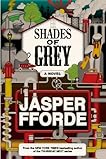
Shades of Grey: The Road to High Saffron (Shades of Grey, #1) Shades of Grey: The Road to High Saffron by Jasper Fforde


OK, I'm not an objective reader here -- Jasper Fforde is my favorite living author -- but this was a lot of fun to read. Not as brilliant as the first few Thursday Next novels, or even the first of the Nursery Crimes, but still I think this series has a ton of potential. It's a zany world of colorblind people, where social caste is based on how much and which color you can see. Also a mildew that is the cause of death for each and every person. Also an antiquated system of marrying for rank, not love. Also Apocryphal people, and highly regulated paint shops, and animals born with bar codes to identify themselves. Jasper Fforde is also one of the few people I can think of who could pull off writing such a funny, comedic book that ends, rather than with a happy couple and Good overcoming Evil, with a sham marriage and deaths of several important characters. And yet I still loved it.

I'm such a pushover for Fforde that I'll give this 4 out of 4 stars, even though I've read better from him, and there were some passages that were a bit stilted (this is by far his most complicated alternate reality yet -- explaining the rules to a colorblind society that can still produce artificial color that everyone can see gets a bit convoluted at times).

4.10.09

Quick Round Up

I've seen some movies recently. (Please refrain from expressing your shock.) Here are one (or so) sentence reviews for a few of them:

Blindsight: Documentary about blind Nepali kids climbing up part of Mt. Everest, in which I found the editing strange, the German blind teacher annoying as hell, but the story nonetheless compelling. 2 stars.

Julie and Julia: One movie trying to tell two foodie stories but failing to tell either one completely and vaguely disappointing because of it. Worth watching once, though, because Meryl Streep and Stanley Tucci are awesome as Julia Child and her husband. 2 stars.

He Loves Me, He Loves Me Not: The "twist" in this movie is utterly ruined if you've heard anything about this movie, or even seen the trailer, so I guess it's not really a twist, but nonetheless it's still stupefyingly predictable. It is fun to see Audrey Tatou as crazy and obsessed, at least. 2 stars.

Criminal: Poor man's Matchstick Men (and probably poor man's Nine Queens, on which Criminal is based, but which I have not seen). Worth it only if you absolutely must watch everything with John C. Reilly or Maggie Gyllenhaal. 1.5 stars

Emma (the 1972 BBC version): Couldn't even get through the first episode. I really don't like Jane Austen as much as I think I should. 1 star.

Norma Rae: Classic unionization story, which deserves its reputation as a classic. Sally Field is great, and frankly I loved the costuming, too -- poor factory workers during a hot summer actually look like it (sweat stains and all). 4 stars.

Seducing Dr. Lewis: Kind of silly but charming Quebecois movie about a small town that needs to convince a doctor to move to town in order to get a factory agree to build there. They decide to trick a doctor into thinking their town is more cosmopolitan than it is, and hilarity ensues. Though it's definitely hilarity of the Quebecois variety. 3 stars.

20.3.09

His Girl Friday

Best movie not under an original copyright. Plus, it's Howard Hawks, Cary Grant, Rosalind Russell, and one of best fast-talking dames in the history of film. And now it's available for free online. Thank you, Hulu.

23.12.08

Pushing Daisies (as promised)

OK, I promised an explanation of why I love Pushing Daisies. Now that the series is cancelled (only three more episodes to go!), it seems sad to write about it, but since I've been spending the last few days trying to convince my sister how amazing the show is, here I go:

The main premise of Pushing Daisies is a bit confusing, and I'm sure it was its demise. Ned is a pie maker who can raise the dead with his touch -- this includes people, animals, and plants. If he touches it again, though, it dies. Plus, if he raises something from the dead for more than one minute, something else of equal "value" dies (e.g., a person for a person, or a plant for a plant). The words make it sound hokey and stupid, but the result is much more magical.

The first magical thing is that Ned's girlfriend is someone he raised from the dead. This means he can never touch her. My sister hates this, but I think it's amazing. First of all, it's very old fashioned. I'm reminded of the censorship days of movies and television, when love stories had to be chaste even if sexually charged -- Ned and Charlotte (aka Chuck) even sleep in separate twin beds with a nightstand in between like all the sitcom couples of old.

Also, I'm pretty sure all romance is about not getting what you want. If you never get it, it's a tragedy. If you get delayed gratification, it's a comedy. Pushing Daisies pushes this definition and creates a tragicomedic relationship. Boy gets girl in once sense, but in another he doesn't (and never will).

The second magical thing is that death becomes malleable. One of my main gripes with modernity is we care so much about death -- we're so afraid of it. Maybe this is just my youth talking, but I'm not sure why we are so scared. Shows with death tend to try to drive this home, making death as sad and overwhelming and ugly as our society perceives it to be (see, e.g., House, every cop show ever, every mob show, even Six Feet Under). Pushing Daisies doesn't make light of death, but it isn't afraid of it, either. People die horrible deaths, but it's never gruesome. And since people can come back to life, but the story doesn't have time for them to go into shock or horror about being dead, it's nice to see characters who don't have a problem with being dead, either. (This reminds me of other Bryan Fuller shows, such as Dead Like Me, which was also brilliant).

The third magical thing is Kristin Chenoweth. She's just amazing -- a funny little spitfire who would be the grounding normal character of the series, if she weren't so quirky herself. In fact, all of the characters are quirky. It's a bit forced at times, but it's nice to know that people don't fit into neat categories -- the hardboiled detective also knits and makes pop-up books, and the shut-in aunts are former synchronized swimmers.

Finally, I love the production design of the show -- I absolutely love the costumes, which tend to be all over the place from 40s to 70s, but always are amazing. I love the visual jokes (Chenoweth's character is named Olive, and she recently got a rain slicker with olives on it, and Emerson Cod the detective's slicker had fish on it). And I love the myriad movie visual references, especially since they are so Hitchcock-heavy (The Birds, Vertigo, Psycho and Suspicion have all been copied. I'm really hoping for the key scene from Notorious before the end of the series, but that may be asking for too much).

Sure, there are faults with the show. The strange premise is often bent or broken -- some things come alive and others don't, but there's no real rhyme or reason to it (dead leaves but not wood? dead fruit but not other baking supplies?). There are a couple of camera and editing problems -- a visual joke involving a one-eyed aunt in the pilot episode was done backwards, and it drives me nuts every time I see it.

But its faults are easily forgotten when weighed against the fact that there's really nothing else like it. For people who like movies and old-fashioned TV more than reality TV or procedural dramas, this is a wonderful show. Plus, Lee Pace is hot.

13.11.08

My new obsession

Pushing Daisies is my new obsession. I found it last week and immediately fell in love. I've ordered Season 1 on DVD and watched all of this season so far at least 3 times each.


More about why I love the show to follow.

22.6.08

Spartacus: mini-review

OK, I've got lots of work still to do this weekend, but something's better than nothing, right? Here's my review from Netflix:

Spartacus is NOT your typical Kubrick in terms of lasting takeaway message -- the nihilism and despair that linger in Clockwork Orange, 2001, and Dr. Strangelove just don't exist here. It is, however, typical Kubrick insofar as it is masterful. There is not an actor in this film that I did not admire more after watching Spartacus -- they all give amazing performances, which is pretty easy, I suppose, if you have such amazing material. This would be worth a spot in your queue just to watch the famous "I am Spartacus!" scene, but it's really oh so much more. It's got layers and layers here, with certain parts of the characters' lives (I'm thinking especially Tony Curtis here) obfuscated because of the Censor Board. But that only makes it better -- you have to actually be thinking and caring about these characters to understand why they do what they do. And it's well worth the effort.

26.3.08

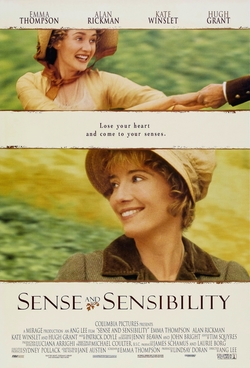
Sense and Sensibility

In honor of my friends who are having a Jane Austen marathon as I post this:

With unfortunate frequency I find myself frustrated at the lack of new movies. I don’t mean there aren’t new releases every week, but rather that they seem to be simple repackaging of the same stories over and over. Now, I know that there are only 36 situations in stories , but at least the story should look new at first gloss, right? Instead, I seem to see constant remakes and sequels of older movies, comic books, novels, even biographies – all of which were better the first time around. Just think of the big movies of summer 2007: Spiderman 3 (a sequel of a comic book adaptation); 28 Weeks Later (sequel); Shrek the Third (sequel of a pop culture/fairy tale mashup); Pirates of the Caribbean, At World’s End (sequel); Ocean’s Thirteen (sequel of a remake). We got another Die Hard movie, and another Harry Potter adaptation. Hairspray was a movie version of a stage production. Even the Simpsons movie was basically just a full-length version of a 22-minute regular episode. Of course, there were a couple new movies (like the brilliant Ratatouille), but adaptations and sequels seem to have taken over the big screen.

I understand the business reasoning behind such endeavors – it takes less work to get people to come to a movie they already know. I mean, Harry Potter movies practically sell themselves just by the title. Even ostensibly new movies get sold as “from the makers of . . .” and even Ratatouille got billed by its connections to prior successes with the Pixar label.

But every once in a long while a beautiful adaptation comes along, making me succumb to old stories. Surprisingly enough, three of my favorite adaptations come from Jane Austen: Clueless (an adaptation of Emma), Pride and Prejudice (not the A&E version, the Keira Knightly version, believe it or not), and the 1995 Sense and Sensibility, adapted by Emma Thompson. My plea to the writers of the many many adaptations to come, if producers remain as risk-averse as they have been lately: learn from Ms. Thompson and Ang Lee, the director (yes, of Brokeback Mountain fame).

The key to a wonderful adaptation is to figure out the essence of the story without feeling burdened by it. A two hour movie is basically equivalent to a novella in length – you just aren’t going to be able to have the plot and character development of a full novel. Don’t even try. The only times it’s ever worked is the A&E Pride and Prejudice marathon and Ken Branagh’s endless uncut four-hour Hamlet. I must admit that though I love Jane Austen stories, the prose gets incredibly cumbersome, which is perhaps why adaptations of her work tend to fare relatively well. No movie is going to take twenty minutes analyzing the quality of the garden hedges, so let’s just cut that wholesale.

Second, feel free to add scenes, but only if you can understand the material enough to be seemless. Apparently, many people have written Emma Thompson or told her that they loved that she kept their favorite part of the book in the movie – a scene about the little girl Margaret being coaxed out of hiding by Elinor and Mr. Ferras pretending to not know any geography. But this scene isn’t in the book. It just fits so well that people thought it was.

Third, remember your medium! My favorite part about the movie is that it’s so clearly a movie. Ang Lee does amazing things with his shots, covering in seconds what takes pages and pages in a book. I’ve seen the movie many times, and every time give a little shudder of delight with the abrupt cutting between Elinor and Mr. Ferras when they are awkwardly talking in the stables. Those cuts make the scene hilarious in a way that even the best comedic adaptation couldn’t do on its own. Mr. Lee also uses the English landscape to set the tone of a scene in a way that would make Ms. Austen proud – one scene, for example, brilliantly uses a long interior shot allows the audience to see the wind rustling the cloaks by the door to create a sense of expectation and foreboding.

Fourth, casting casting casting. The cast in Sense and Sensibility is basically perfect. Costume dramas are hard to cast, as the horrible miscasting of Keanu Reeves in another Emma Thompson movie makes clear. You have to get people who are comfortable with language, and who make sense for the parts. If there’s every a place to typecast, this is it, and Sense and Sensibility does so with a loveable but inept Hugh Grant as Mr. Ferras (does he ever play any other part) and Alan Rickman as the kind but brooding Colonel Brandon. Kate Winslet plays young and impetuous Marianne well, which probably was less playing and more just being a nineteen-year old who lied about her age to get the part. If the original source uses physical attributes to display character traits, by all means do so in your casting here, as the rotund and ridiculous Mrs. Jennings (played by Elizabeth Spriggs) and the haughty and pointy-nosed Fanny Dashwood (Harriet Walter) exhibit.

All in all, this adapation is everything an adaptation should be – great story that’s made into an equally great movie, with a brilliant cast (some of whom got their big breaks here) and a brilliant script and brilliant director. 4 stars.

15.3.08

Bull Durham

I finally got around to watching Bull Durham last week. I think I put it off for two reasons: 1) it's supposed to be an amazing movie and 2) it's about a place and a team I grew up watching. The mixture of the two just couldn't live up to expectations, I thought. And that famous speech that's supposed to be so amazing ("I believe in . . .") I had seen as a clip and it wasn't that impressive.

Well, that speech still doesn't move me the way it apparently does everyone else. But all the rest of my worries were thoroughly dispelled. Susan Sarandon is the heart of this movie, and she controls both the plot and the screen. Next to Vivian Leigh in Gone with the Wind, this is certainly the best southern woman role -- may be the best female role period -- in the movies (yes, even including Katharine Hepburn and Elizabeth Taylor roles). She's smart, powerful, experienced, wise, silly, conflicted, and searching all at once, and it's a joy to watch Sarandon swim around in the depths of her character.

And then there's Tim Robbins, who is so much funnier as the talented but naive rookie than I ever realized he could be, since I mostly know him from The Shawshank Redemption and Mystic River. He's great in a totally different way from either Susan Sarandon or Kevin Costner (who is probably the most predictable and boring character of the three: the wise but frustrated older player -- but Costner does it well, as we all know he can from all those other sports movies he's been in).

Then, there's the plot. I won't go through the plot here, since it's classic enough that plenty of others have done it thoroughly. But I hadn't known before I watched the movie that it was written and directed and produced by men who had actually been minor league baseball players, so there's a fidelity to reality that I hadn't expected. I mean, authenticity isn't exactly what makes sports movies popular. People watch sports movies for the same reason they watch sports: to see their guy win. The only other "authentic" sports movie I can think of is Bad News Bears, which I don't actually like that much for some reason or another. But here, sports isn't about a team winning or losing, it's about a bunch of guys trying to make money and getting girls and prolonging adolescence as much as possible. Though I've never known a minor league baseball player, it seems to me that would be pretty spot on.

Finally, there's Durham. Thank goodness they did it on location. Those dingy brick building, the clay that's practically in the air, the potholes in the roads on the outskirts of Durham -- these details make me homesick, believe it or not, but also lend credence to the size of the characters' world -- the idea of the major leagues does seem like a paradise when you're working in rundown towns with working class spectators, and not too many of them at that. Sounds depressing, but the movies that affect me the most tend to be those that realize that the big dreams of ordinary people are important and inspiring and engrossing, at least to the people who live them.

4 stars.

26.7.07

Keeping Mum

Keeping Mum follows a country vicar and his family, an archetype the British apparently find ripe for comedy. In the grand tradition of British Comedies about Vicars, the film is chock full of eccentric characters, and there are passing jokes about flower committees and country church politics, as well as making puns and other small lingual jokes that make you either love watching BBC sitcoms or not. (The town is called Little Wallop, for example, and the family portrayed is the Goodfellows.) What distinguishes this movie from the rest is its light handling of dark subject matter. Insanity, murder, adultery, and voyeurism -- along with normal family tensions -- are all included, but they are treated with wit and humor (and never make the film very graphic, either sexually or violently). The R rating comes from the number of greusome subjects and the frank way in which the characters engage in such behavior. This is not the Censor Board era, where you might miss the references if you don't know what's going on, but visually at least things are left to the imagination, which I appreciate.

While dark in subject, the film is actually quite deft in its handling of the subjects, and the characters who would be abonimable in real life somehow manage to be loveable. This is where a star cast really comes in handy, and the talent recruited here prove they are up for the task. Rowan Atkinson's recent work has completely redeemed himself from his Mr. Bean days, and here he remains in my good graces. As the vicar Walter Goodfellow he is clueless in a manner only vaugely reminiscent of his more famous character, and he introduces a sensitive and humanity that keep this film from becoming entirely about its crazy plot points and instead grounded firmly in the characters and their relationships to one another. In the film, Walter is struggling with mediocre sermons and neglects his wife Gloria, played with equal loveability by Kristin Scott Thomas. Gloria is just starting an affair with her golf pro (played to smarmy perfection by Patrick Swayze - yes Patrick Swayze - who seems wonderfully out of place in a small British comedy), their teenage daughter is acting out by having promiscious relationships with "bad boys," and their son is being bullied at school.

Enter Grace (Maggie Smith), a housekeeper who is an unassuming, gracious, maternal, quiet -- in a word, perfect -- older woman. She quietly starts up-ending the Goodfellows' lives, and gently reminds them what it means to be a family. Perfect little happy story, with only one monkeywrench thrown in: Grace has recently been released from a mental institution for calmly murdering her husband and his lover, an event we see at the very beginning of the story. Ms. Smith plays this insanity with understated aplomb, which matches the whole movie's tone perfectly.

The wonderful thing about the "insanity plot twist" is that it isn't a twist: the audience knows about this little problem from the very beginning of the movie, even before meeting the Goodfellow family, so the humor genuinely comes from the earnest acting combined with morbid situations that Grace brings with her in addition to perfect housekeeping, rather than from any shock value. The best part of the comedy simply comes from the strangeness of an insane killer bringing sanity and peace to a household, and though the joke lasts for the whole movie, that one note sustains quite well because of the cast. Even though the situations are over-the-top, the actors never are, making the film's world incredibly easy to believe, which makes the whole thing even funnier.

5.7.07

Babette's Feast

Ask almost anyone what his favorite food is, and it's unlikely you'll get the same response as if you had asked what the best meal is he's ever had. Once in a very long while, however, intellect and emotion converge, and "good" food corresponds with "favorite" food. With me, though, this convergence happens almost exclusively in food that is exquisite because it is simple but perfectly executed with just the right ingerdients: a fresh loaf of ciabatta (five ingredients, but it’s all about time and kneading), chocolate mousse (four, but the egg whites must be folded the exact right amount), green beans with just a bit of salt and olive oil (OK, there’s no real technique there. The beans and olive oil just have to be high quality.).

Movies work the same way. There are some incredibly good movies I've seen that will never be my favorite movies because they are just too heavy (or too long, or too bloody – the analogy still works in each case). Meanwhile, some of my favorite movies are definitely the film equivalent of empty calories, predictable comfort food, or dishes that you love simply because they bring back good memories. And then there’s that rare movie that can both be counted as a favorite and an artistic accomplishment.

Babette’s Feast is one of those rare movies. Like those special foods, it succeeds precisely because it is simple in its aspirations, but meticulous in its details. The story was written by Danish author Isek Dinesen and first published in the 1950s in the Ladies Home Journal. The title character is Babette Hertsard, a French refugee in the 1800s who finds herself in a remote fishing village on the coast of Denmark. The village is simple, humble, and devoutly religious, and Babette becomes the servant and cook for two elderly sisters whose father founded the devout religious sect the village people follow. Babette’s only tie to her French (read: more worldly) past is a yearly lottery ticket. One day she wins that lottery, and decides to thank the sisters for the past fourteen years by cooking them and their congregation an elaborate meal.

The 1987 Danish film benefits from its humble and succinct beginnings. Because the movie primarily revolves around the preparation of a single meal, there is no rush to just move through the plot, and instead the film can linger over the visual details and delve into the characters’ nuances and intriguing pasts. The plot quietly progresses, and before you realize it, there is a final satisfying twist that I didn’t predict only because I was enjoying the movie too much. The cinematography savors both the food and the countryside, and the result is beautiful. The juxtaposition of the sumptuous meal and the ascetic village enriches the portrayal of each, and gives the film most of its depth and texture. Better still, in the end this juxtaposition seems to melt away, leaving the viewer to realize that Babette’s loving and extensive preparation bears more similarity to religious devotion than one might realize; eucharistic undertones develop, and the woman anointing Jesus with expensive perfume comes to mind.

While the meal portrayed in Babette’s Feast may be elaborate and extensive, the movie itself is exactly like my favorite foods: complex in its simplicity and made of really good ingredients. Also like most of my favorite foods, the enjoyment of Babette’s Feast is not without labor. With food, you have to invest time and technique; with Babette’s Feast you have to sit through a slow beginning and read subtitles. But it’s well worth it.

7.6.07

Harvie Krumpet

An unlucky little clay man, Harvie Krumpet, and the movie to which he donates his name, represents the best that storytelling has to offer. First of all, this movie is funny. From the slightly random fact that Harvie’s real name is Harvek Milos Krumpetzki to the downright ridiculous events of his unfortunate life, Harvie’s life epitomizes simple humor. And Geoffrey Rush, who the filmmakers rightly claim is the Godfather of Australian Film, expertly narrates the tale with just the right balance of sincerity and irony to make every scene even funnier.

Second, the story is poignant. Harvie is born desperately poor. Then he becomes a refugee to Australia during World War II. He had Tourette’s syndrome, gets struck by lightening, loses a testicle (I forget how – I haven’t seen the movie in four years), and eventually gets Alzheimer’s. And yet, Harvie remains simple and optimistic. A perfect example of enjoying the simplest pleasures of life even in the face of a life others might regret or complain about, Harvie plods along in his life, armed with a book of Fakts (another source of funny lines) and unending good nature. He gets married, adopts and raises a thalidomide baby, works for animal rights and even in his old age become a nudist. (And let's just say that this being claymation makes this a lot more funny than if this were a live action short.)

Last, this story is airtight. At only 23 minutes, this movie chronicles Harvie’s whole life, from birth to death, and somehow seems to get plenty of story in. Not a line is wasted, and every detail – visual or otherwise – is there for a reason. It’s enough to make me angry that it’s almost impossible to find a place that shows or sells movie shorts (there appears to have been no American DVD release). But if Harvie Krumpet didn’t complain about his life, I suppose I can’t complain too much. After all, I caught this short almost by accident back when I lived in Chicago, so really my luck is much, much better than Harvie’s.