Showing posts with label 2 stars. Show all posts

26.2.10

Kitchen Chinese

Kitchen Chinese: A Novel About Food, Family, and Finding Yourself Kitchen Chinese: A Novel About Food, Family, and Finding Yourself by Ann Mah


I really should have known better. I thought it would be a novel about food -- it's called Kitchen Chinese and was written by a food writer. But it's actually chick lit. Reading the back cover, I realize I should have seen the signs: "Isabelle Lee things she knows everything about Chinese cuisine. . . . Now, in the wake of a career-ending catastrophe, she's ready for a change -- so she takes off for Beijing to stay with her older sister, Claire. . . . . In the midst of her extreme culture shock, and the more she comes to learn about her sister's own secrets, Isabelle can't help but wonder whether coming to China was a mistake -- or an extraordinary chance to find out who she really is." Sister's secrets? Discovering yourself? This could be an interesting, insightful book, but it could also be incredibly cheesy chick lit.

It's the latter.

It's pretty decent as chick lit goes, but chick lit nonetheless. It's predictable, a quick read, and best when it sticks to food and personal revelations rather than dating, broad assertions about the nature of cross-cultural experiences, and sibling rivalries. (I correctly guessed that the writer is an only child simply from the way she wrote about the main character and her sister. It was just too discombobulated a mess of rivalry, grudges, lack of communication, and yet also intuitively knowing what the other needed and thought.)

Ann Wah admirably figures out how to write bilingual dialogue, explaining important phrases but not bogging down comprehension with a dual system. I got a little annoyed that the pinyin had no tones, but that's not Wah's fault, and for most English readers I dare say it's less distracting to get romanizations of Chinese without little lines above each syllable.

Wah also shines when she talks about Chinese food, which actually made me hungry for Chinese street food more than once. And this may be the first book I've ever read that truthfully explains the awkwardness and avoidance that leads to really unacceptable ways of breaking up with someone. As in, I had total empathy for the text messager in the story, even though I still know it's a despicable thing to do.

However, the book felt too autobiographical -- too many details that didn't make sense to put it unless it was just an observation the author personally made and wanted to include. Yet at the same time, the book was too fake. Sometimes the dialogue was awkward because it tried to explain things without making a proper aside (like when the main character's best friend in China explains to her that she rides a bike to work -- gah!! main character would know that already, so it shouldn't be dialogue, but part of the narration). Or the narration sounded weird because it became too colloquial/talky, as when the main character explains that in middle school, "Shannon and I soon became BFFs." Really? "BFFs"?

But the stylistic awkwardness would be forgiven if it weren't for the totally lame love interest plot. I give Wah points for not even trying to pretend that she's come up with something suspenseful -- she makes it painfully obvious who the main character is going to end up with moment she meets him. It's just too too "meet cute" not to end with some ridiculous mushy dialogue at the back of the book. But it did annoy me that the reader is introduced to the romantic interest on page 68, I figured out who he was by page 69, and the main character doesn't figure it out until page 204. I mean, being a little dense is one thing, but if you know a guy named Charlie is going to be at an event that is honoring a guy named Charles who you know works in the SAME OFFICE, don't you think you might, just might, put 2 and 2 together? What works in crappy romantic comedy movies doesn't work quite as well in first person narratives because narrator has to both give all the necessary information and be stupid enough not to know what's going on.

But all in all, Kitchen Chinese was enjoyable enough, especially for its descriptions of China and Chinese food. It's not particularly thought provoking, but it's worth reading over a weekend or on the beach. As long as there's a Chinese restaurant nearby to fulfill your cravings.

11.2.10

To Be Or Not To Be

Back in high school, one of my friends told me I should watch this movie, but I kept putting it off because the premise seemed strange (see below). I understand why my friend thought I would like To Be of Not To Be: I love Shakespeare. I love 40s comedies. And (until this movie) I particularly like the 40s director Ernst Lubitsch, who directed one of my favorite movies, Ninotchka, as well as The Shop Around the Corner, the sweet little movie on which You've Got Mail was based. So I'm a bit sad to report that To Be or Not To Be actually creeped me out more than entertained me. I don't think it means to be a black comedy, but this is by far one of the darkest I've seen.

Don't get me wrong. The actors are great. Jack Benny is very funny, and Carole Lombard is the definition of a star: luminescent and radiant. But I just couldn't get over the fact of this movie: a 1942 film about the Nazi occupation of Poland. Basically, the story revolves around a Polish theater troupe in Warsaw that gets sucked into high espionage when a star struck young bomber pilot in England accidentally asks a German spy to get a message to the woman he loves -- actress Maria Tura, played by Carole Lombard. The pilot finds out that the spy has information that will destroy the Polish Underground, along with all of the Resistance movement in Eastern Europe. And so he flies back to Poland to intercept the spy. In the process, Maria Tura, her hammish actor husband (played by Jack Benny), and the rest of the troupe go through hijinx galore to save Poland, the Resistance, and their own skins. Jack Benny wears a false beard and losing a mustache out the window of a car, while Carole Lombard seduces no less than three Gestapo officials within the span of 24 hours. There's a comedy routine with a corpse. A bit player dresses up as Hitler with a little mustache and fools about two dozen Gestapo guards into following him and deserting the real Hitler. Seriously, folks??

The hardest part about this movie is that, because it was made in 1942, it couldn't give a conclusive ending. Who knew who was really going to win? Instead, a few good people make it out of mainland Europe and on a plane to England. Not exactly a triumphant ending. I'm sure Lubitsch -- a German-born Jew -- could not have thought that comedy alone could mask the uncomfortable task of making a movie about the Polish occupation while Poland was still occupied. Several times throughout the movie, a bit player in the troupe (played by one of my favorite Lubitsch regulars, Felix Bressart) who dreams one day of playing Shylock in The Merchant of Venice keeps reciting the "If you prick us, do we not bleed?" speech. It's always a poignant speech, and Lubitsch lets its emotional weight come through each time, right before cutting away to more slapstick. It's a strange juxtaposition that echoes the even stranger juxtaposition of the movie itself, which played in theaters along with news reels about the realities of concentration camps and the war in Europe. The thought of this movie being made when the outcome of World War II was still uncertain is flabbergasting to me -- the movie is incredibly brave to treat the Nazis with such derision as well as humor, but also massively strange and unsettling if you didn't know the third act would end out all right, as it were.

In the end, I could never get over the oddity of the movie to actually enjoy it. Slapstick comedies are supposed to be heart-warming, or escapist, or something, not awkward and macabre as this one is. When it's ill-timed, laughter is not the best medicine.

2 stars -- good but falling far short of delightful.

21.1.10

Eep! It's 2010!

I can't believe I haven't posted in two months! Time does get away, doesn't it? It's particularly sad because I've watched a bunch of movies and even read a few books in the last couple of months. And if I don't write down my thoughts, there's a chance I'll forget I've even seen something. As happened just this week when I told a coworker I hadn't seen Can't Hardly Wait. No wait. I have. Oh, sure, yeah, I thought it was *really* good -- can't you tell what a lasting impression it made?

So, because I'm lazy, but still feel guilty that I haven't posted yet in 2010, I'll just lift a few of my short Netflix reviews:

The Dress Code (2000): The writers here must have thought quirkiness equals character, so there's a lot of the former and little of the latter. But the actors make up for it and deliver wonderfully nuanced performances that only hint at the depths of the people portrayed. The end felt a little forced, but I didnt care by that point -- I was too charmed by all the actors, from Alex Linz (the little boy) and Stacey Halprin (the mother) to the big name stars. All in all, a nice little story. If you like this movie, I also recommend Saint Ralph. Its in a similar vein, and I liked it much more than this one. 2 stars.

Easy Virtue: Where is the Noel Coward wit? It's there, but it's hidden, and I found myself wanting more brandishing of that wit than faux-20s music and overly staged sets. There were a few really good moments, but they're in the preview. This one barely earns its three stars, but Kristin Scott Thomas bumps it up a notch. She is the one razor sharp character among a pile of dull blades. And without equal blades, a jousting contest is just not that interesting. And to top it all off, I wouldn't actually classify this as "romantic comedy," which is clearly what the studio is going for. Just look at who they cast -- I thought Colin Firth *meant* sappy romantic comedy! Plus, they totally sell the happy-go-lucky side of the movie in the trailer, product description, and even classification for Netflix. (Actually, I don't know if the studio suggests the classification, or if Netflix does that. But whoever did it, it's misleading.) This isn't Oscar Wilde and it isn't An Ideal Husband -- not exactly a happy ending here. 1.5 stars.

Two Brothers and a Bride: I was surprised how much I liked this movie. Basically, it's about two brothers who run a farm who go to Russia to find a wife to take care of them after their mother dies. David Arquette and Tim Blake Nelson star, along with Emily Mortimer as a journalist in Russia who starts following them around for her documentary on mail-order brides. Given the premise, it could have come out very preachy ("Bad human-trafficking-type business!") or misogynistic ("Ha-ha! Look at the funny desperate Russian women, or the silly feminists!") or make cruel fun of two farm boys ("Wow they are such hicks, and stupid, too, for being unable to take care of themselves without their mother"). Instead, it is a small but lovable movie that refuses to condemn any of the characters, even as it does recognize the ridiculous in almost all of them. Plus, you get the pleasure of very good performances by Mortimer, Arquette, and Nelson. Not a must-see, but a nice change of pace from your typical meet-cute romcoms. 2 stars.

4.10.09

Quick Round Up

I've seen some movies recently. (Please refrain from expressing your shock.) Here are one (or so) sentence reviews for a few of them:

Blindsight: Documentary about blind Nepali kids climbing up part of Mt. Everest, in which I found the editing strange, the German blind teacher annoying as hell, but the story nonetheless compelling. 2 stars.

Julie and Julia: One movie trying to tell two foodie stories but failing to tell either one completely and vaguely disappointing because of it. Worth watching once, though, because Meryl Streep and Stanley Tucci are awesome as Julia Child and her husband. 2 stars.

He Loves Me, He Loves Me Not: The "twist" in this movie is utterly ruined if you've heard anything about this movie, or even seen the trailer, so I guess it's not really a twist, but nonetheless it's still stupefyingly predictable. It is fun to see Audrey Tatou as crazy and obsessed, at least. 2 stars.

Criminal: Poor man's Matchstick Men (and probably poor man's Nine Queens, on which Criminal is based, but which I have not seen). Worth it only if you absolutely must watch everything with John C. Reilly or Maggie Gyllenhaal. 1.5 stars

Emma (the 1972 BBC version): Couldn't even get through the first episode. I really don't like Jane Austen as much as I think I should. 1 star.

Norma Rae: Classic unionization story, which deserves its reputation as a classic. Sally Field is great, and frankly I loved the costuming, too -- poor factory workers during a hot summer actually look like it (sweat stains and all). 4 stars.

Seducing Dr. Lewis: Kind of silly but charming Quebecois movie about a small town that needs to convince a doctor to move to town in order to get a factory agree to build there. They decide to trick a doctor into thinking their town is more cosmopolitan than it is, and hilarity ensues. Though it's definitely hilarity of the Quebecois variety. 3 stars.

30.8.09

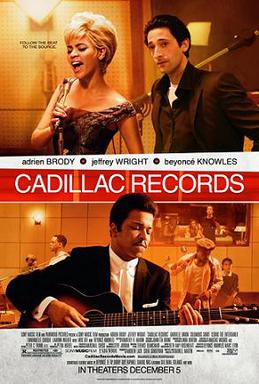
Cadillac Records


Verbatim from my short Netflix review (except for a change from a 5 star scale to my 4 star one here):

The history of Chicago blues deserves an amazing movie -- Muddy Waters, Etta James, Little Walter, Chuck Berry, Howling Wolf, and many others who aren't even mentioned in this movie led the dramatic lives that only bluesmen seem to live, and at the same time changed music, Chicago, and race relations forever.

Unfortunately this movie isn't amazing. It's entertaining enough, and the star-studded cast all have incredible talent, both in acting and in making music (which all the actors do on screen rather than dubbing it in). But the script tries to cram too much in at a time and ends up failing to do justice to these men and women's lives. This movie is too scattershot, with too many characters in the ensemble given too little screen time to explain their presence. If you don't already know who Howling Wolf is, for example, this movie won't really tell you. If you don't already know of him, his character is like an inside reference that you just don't get. At the same time, the movie is too generalized and too historically inaccurate to satisfy real blues fans. And if you know the songs being sung, they are off by just enough to drive you crazy (especially, for me, the Etta James songs, no matter how talented Beyonce is).

I was so ready to adore this movie, because I adore Chicago Blues. Instead, all I can say is that it inspired me to listen to my old CDs with Etta James, Howling Wolf, Muddy Waters, and all the rest, and made me want to read a real biography of the Chess family. That's enough to warrant a very solid two stars, but I'm so sad I can't give it more.

15.7.08

The Women


If you don't know anything about the movie The Women, at some point you will feel there's something off about it. Something strange; something forced. I'm not quite sure when you'll realize it, but it'll happen. You see, there are 130 speaking roles in the movie, and who knows how many people on screen. The movie is set in homes, and department stores, and spas, and other semi-public places and yet it seems that half the population has been deleted from the screen. Not a single man or boy appears on screen during the whole film.

We're used to seeing movies with mostly or only men. I don't remember any women in The Great Escape, or any in Platoon. No wait, there were some mothers in the village in Platoon. It's hard to just take women out of village scenes after all, even if they're just for show.

And that's my problem with The Women -- unlike war movies, where the lack of women is actually an issue, and represents a loss to the men, this movie just deletes men as if they don't matter. This sounds like an extreme tactic to be all about women, to be a proto-feminist movie about the issues and foibles and world of "women only." But actually, the whole movie is about the crazy competition that women have with each other in order to get men. Like a No Boys Allowed sign outside a bunch of grade school girls' secret hideout where they gossip about boys, The Women is, as its DVD case proudly proclaims, all about men. Apparently, the lives of these women revolve completely around men -- whose husband is having an affair, which rich bachelor can be hooked into being a woman's next husband after Reno, and on and on.

Now let's be fair about this: there are few movies with the star power of the Women. Made in that glorious year of Hollywood, 1939, it's got so many excellent actresses that there were problems with billing and who got to have the biggest names on screen. Apparently Norma Shearer had written into her contract that no one's name could be bigger than hers in the title credits (except for a leading man's), but damned it Joan Crawford wasn't getting at least as good. So they both got huge lettering, and Rosalind Russell had to be content with smaller letters and just stealing the show with her portrayal of the completely over-the-top gossip Sylvia Fowler. There's also Paulette Goddard (Mrs. Charlie Chaplin), Joan Fontaine (who was in Hitchcock's Rebecca) and Mary Boland (who you probably have never heard of, but she's brilliant as the worldly but silly, "in love with being in love" Countess DeLave).

And it's also a comedy of manners, sort of a female version of Oscar Wilde, spearing gossipers and the scheming ways of rich housewives (remind you of any reality TV these days?). I love these sorts of comedies, and I love those women lighting up the screen. So why didn't I like this movie?

It's not just about the No Men on Screen gimmick. It makes sense for a play, and I applaud the idea of seeing if it would work, even if it's a bit forced. But -- can I even allow my feminist self to say it? --- these women need men. Without men on screen to actually fight for or even fight over, all of the women's catty tactics towards each other just play out in a vacuum, and I could never really care about who got the guy in the end. Without men, you could never see these women be sexy and smart and winsome; they're just fighting with each other. Without men anywhere to be found, their world seems impossibly small and trivial. Where is the outside world? Where are the working classes on the streets of Manhattan (both men and women) where this movie supposedly takes place?

I often love the women in movies made around this time. The dames, the sidekicks, the gamines -- they might all exist before the glorious sexual revolution of the 1970s, but those women had it figured out. They knew how to fight to be equal with men but still be women. Think of Rosalind Russell in His Girl Friday just one year later -- a fast-talking reporter who can give and good as she gets from Cary Grant. Think of Katharine Hepburn in Woman of the Year, playing a brilliant, high-powered political columnist. Think of Barbara Stanwyck in basically anything she did. For goodness' sakes, even think of Vivian Leigh in that movie made the same year as the Women. Instead of being a smart, funny movie about smart, funny (if also conniving) women, The Women ends up just making the women small and ugly -- even if their names were big up there on the screen.

28.4.08

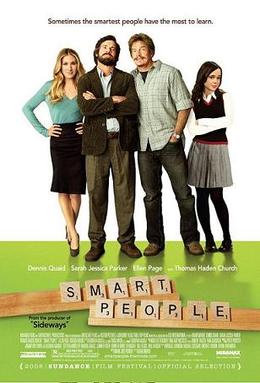
Smart People


Smart People fits into the mass-audience pseudo-indie film category that some of the most popular movies of the past few years (Juno, Napoleon Dynamite) come from. But with over-exposure comes being over-done. This is a passably enjoyable film, exhibiting both the best and the worst of the genre.
On one hand, all the actors (except SJP, who mostly just looks like she's mixing Family Stone with SATC and hoping that'll pass as acting) inhabit their characters incredibly, revealing their fear and vulnerability under the hard exteriors that come with being "smart" and "successful." I really loved the poignancy of Ellen Page's character -- a high school girl whose desire to live up to her father has sapped her of her childhood. Dennis Quaid, as lonely, over-compensating misanthropic professor, is also amazing.
Unfortunately, the great performing suffered from a script at times too obvious ("We're smart people; we'll figure it out" is a bit of a 2x4, no?) and direction too blatant (a brilliant bit with Thomas Haden Church's character posting signs on telephone poles is almost ruined by calling too much attention to the gag). And, the story has too many haphazard events unnecessary to the resolution of the film (I'm thinking mostly of the son's girlfriend, the recommendation letter, and the pregnancy).
In the end, though I enjoyed it, I wish the movie had lived up to its name and been a little more, well, smart.

2.5 stars.

17.4.08

Play Misty For Me


Clint Eastwood is my mother's favorite actor, and so, in honor of the approaching holiday in her honor, I watched Clint's directorial debut. (OK, well, I didn't really watch it for that reason, but I did watch it in large part because I grew up with my mother gushing over the man.) I must confess horror movies don't generally do it for me. With the exception of Hitchcock and his disciples, I can never really get into them. I don't particularly like gore -- it either grosses me out, or just as often looks way too fake for me to do anything other than stare at it with an amateur director/critic's eye and just be unimpressed. And the whole idea of being scared or "thrilled" rarely works differently -- the only movie that has come even close to freaking me out since I was 16 and started watching R rated movies was The Shining. Everything else just seems too contrived for me. It's so formulaic that there's no horror involved -- you know exactly who's going to die or get hurt and when, and that just takes all the fun out of it. It's not like romcom, where the formula supports the genre; horror is supposed to surprise and startle you, but if it's so obviously working off something as predictable as sewing patter, well, I'm not sold.

So maybe I'm not the best person to review this piece with a favorable eye, but while I thought the movie was decent, my main comment is that Play Misty For Me has become a period piece -- everything about it is steeped in the early 70s, which is fun to watch but even more distracting to the idea of a thriller. Even the suspense seems dated: a quaint idea based on the premise that someone would meet a woman, slowly realize she is suicidal and has psychotic episodes, and then proceed to do nothing about it until all sorts of havoc has been wreaked. However, if you can get over the things that date this movie, it's quite enjoyable: the actors are all young and passionate (I mean that in all senses of the word) and the plot makes for a simple vehicle for them to chew scenery and revel in 1970s California, which is shot quite beautifully (red woods, ocean, and cliffs abound). The direction is sometimes predictable (lots of shots that seem omniscient and then you realize they are point of view shots, for example), but it is worthy enough to foreshadow the much better work that Clint directed later, from Unforgiven to Mystic River to Million Dollar Baby.

1.4.08

The Aviator


Confession: I am not a Martin Scorsese fan. Raging Bull was fine, but I definitely wouldn't rate it as the fourth best American movie ever. But eventually the perpetual hype got to me, and I put The Aviator in my DVD player with great anticipation. A three-hour long movie (170 minutes, to be exact) that got rave reviews has to be riveting, right?

Unfortunately, the other option for a 170 minute movie is that it's overblown with its own importance. Granted, it fits well with the subject matter here -- it appears that Howard Hughes was a pretty self-important man -- but Mr. Scorsese seems to forget that a movie is still a movie no matter how long, and it would have been nice to feel like there was a reason for my watching rather than seeing a scattershot of events that happen to be roughly true.

For those of you who may have missed it, The Aviator outlines the life of Howard Hughes, the great filmmaker and aviator, from the late 1920s to the 1940s. (Howard Hughes produced Hell's Angels, Scarface, The Outlaw, and a slew of films noir in the '50s, and set multiple air-speed records during his lifetime.) I'm not quite sure why the timeframe of the movie was chosen -- after a brief prologue of a scene of Hughes as a child, it jumps straight to the production of Hell's Angels, which wasn't Hughes' first movie. And it stops after he successfully tests the Hercules, a huge aircraft that spent him years to make, but before he took control of RKO, or severed his relationship with his longtime assistant Noah Dietrich, or founded the Howard Hughes Medical Institute. Maybe this would make sense if we assume that everyone knows about Howard Hughes's story and his descent into madness in his later years, but let's not assume that a movie-going public that is mostly teenagers knows about a rich and crazy guy who died in the 70s.

As for the movie itself, the best part about the movie was that it was star-studded as Howard Hughes' apparently was: big names played bit parts for the chance to be in a Scorsese film, and it was fun to watch Gwen Stephani, Jude Law, Ian Holmes, Alan Alda, and a bunch of others in fairly small roles. Leonardo DiCaprio does a good job playing a part with almost no guidance from the script as to a story arc. Now, I know people's lives don't necessarily have climaxes and turning points and drama to their days, but if you're consolidating a life (or part of a life) to a few hours, you've got to have a reason for what you see and what you dont. Now, I don't mean that I need to know why Hughes went mad, for example, but hinting that it was a childhood thing but not exploring that just frustrated me, and to have character after character march in and out of his life isn't helpful to understanding his life. Similarly, Cate Blanchett does a passable job as Katharine Hepburn, but her role seemed more about imitation than acting -- the problem with playing a person that spent a lot of the time on film herself. In the end, I felt like the movie was less a story than an observation/impersonation, which seems a waste of time and talent to me. Even documentaries are supposed to be edited to have a direction to the story it tells, but this was just sprawling and pointless even though it was larger-than-life and impressive to watch. Maybe that was the point: that Howard Hughes' life was jam-packed with action, danger, risky business moves, Hollywood stars, and paranoia, but in the end didn't have much direction or purpose. But if that was the point, I'd rather read a biography that really explores the whole life and wonders why his life was both so amazing and so screwed up. Just watching some random, disparate parts of a man's life for three hours was about double the time I was willing to spend. Note to future Scorseses: Editing something to make it shorter generally makes it better, not worse.

2 stars

20.3.08

The Skulls

I went ahead and watched The Skulls, which I posted in its entirety just a couple entries ago. I had watched it a few times in high school as one of those trashy movies you put on in the background during a sleepover, so it brings back fond memories for me, even though I couldn't remember the plot at all. In fact, I could only remember two things about the movie before watching it: that at one point the main character says "Hell yes!" instead of "Hell yeah!" which was the topic of conversation during one of these sleepovers, and that there were a couple beautiful scenes, by which I mean the visuals (aka people) are beautiful, not that they are written beautifully or anything.

My review, then, is colored by the movie sending me back to high school, so please cut me some slack when I say I enjoyed it. It is the movie equivalent of one of those mystery/thriller novels you buy for summer reading: sleek, cleverly crafted and terribly fun, even if it's not "highbrow" fare. Joshua Jackson and Paul Walker are sexy and assured in their roles as two very different undergrads at Yale -- the working class boy and the rich legacy boy -- who both become members of a secret society. The working class boy (Jackson) is the main character, of course, and the one with the ethical convictions, of course, even if those convictions waiver for a while in the face of the riches and opportunity that come with being part of the elite Skulls. When his best friend dies while trying to write a newspaper story on secret societies, Working Class Boy calls on the help of Trusty Female Sidekick/Love Interest to help free him from the clutches of his new pal, Legacy Boy, and the rest of the powerful members of the Skulls. The plot is moderately well developed (even though it's trite and the end feels slapped together at best), and Leslie Bibb does a wonderful job as the only female role of any substance and the only character who seems to have normal human reactions -- like screaming in fear -- to the things going on around her. There are some fun lines and slick moves on the part of the main characters, even beyond that "Hell yes!" scene. So while there are very few interesting characters for a conspiracy-theory story, and while the characters sometimes become caricatures, and even while Paul Walker can't shake being too stiff at times, it's enjoyable enough to pull it out of being a complete mess.

2 Stars

19.3.08

The Jerk


I just watched my first full length movie on hulu and would first like to mention that this service and the others like it aren't going to kill the DVD any time soon. Even with my high speed internet in a college town, the picture stopped pretty often to "buffer" itself, and of course the resolution was no match for the full screen of my beautiful 15" apple computer. But most importantly, when you have to create a login to watch an R rated movie like The Jerk, you sort of expect it not to be a censored version of the movie. One of the most pervasive jokes in the movie is a dog named S***head, but in this movie his name was dubbed to Stupid. This completely changes the joke, and though it might not be extremely funny in my opinion the original way, it certainly doesn't hold up to repetition when it's just Stupid.

Given this movie's cult classic status (see, e.g., episode 14 here), I was actually a bit worried to watch it. I expected not to like it very much, because most of the time my humor isn't the same as a 12 year old boy's. And while I love the SNL spawn of Blues Brothers [music in link], I don't buy into the idea that all SNL touches is gold.

Thank goodness it was just a rehash of a lot of Steve Martin stand-up routines that I already knew and loved, like Cat Juggling, which is on the marvelous record A Wild and Crazy Guy. Like some of the best comedies, the plot seemed a loose connect-the-dots between gags and jokes for the starts of the show, a formula that worked well for a standup comedian like Steve Martin. With some great lines ("You know, you can tell so much about a person from the way they live. Just looking around here I can tell ... you're a genuinely dirty person," "That guy gypped me; he put daisy stems on my roses!" and yes, I'll even give you "He HATES these CANS!" ), Martin really carries the movie to a loveable place, and somehow even the incongruity of Bernadette Peters in such a slapstick movie seems part of the joke rather than a factor working against it. And, really, who wouldn't laugh at those juggled cats?

Then again, it was kind of a rehash of routines I already knew, like his bit about what happens to a guy when he tries to ask a girl out (frankly, I like the stand-up version better). It's a good movie if you've never heard it before, and a decent one if you have, but even with a running time of 1:35 some of the jokes feel tired by the end.

I can't say I love this movie, at least my first time around. Although it does seem obvious to me how it would get better the more times you see it, just waiting for the next of your favorite oh-so-quotable lines to come around.

2.5 stars

P.S. A little research revealed that the cable-edited version I saw did include some scenes not in the original, like the Tilt-a-Whirl scene (which I felt went on too long) and the cracked leather airplane seat conversation (brilliant). Don't know if that changes anything, but for any aficionados I may have offended with this review, maybe that's the difference. Well, that and all that buffering.

16.4.07

Le dîner de cons


About half-way through watching Le Dîner de Cons (translated to The Dinner Game) last week, I realized it really should be a play. And, after a little research, I found it was originally written for the stage in 1993. I'm glad I found this out, and I wish I had seen it on the stage rather than as a film. The story is definitely better suited to the stage - not much happens, and it's mostly an exercise in self-reflection. It's a nice little movie, but it is just that: little. It never grows out of its self-imposed four walls.

The international title of the movie doesn’t do the title justice. A literal translation reveals much more: The Idiot Dinner. The entire plot revolves around a French intellectual and the “idiot” he has picked up to take with him as a sort of trophy to a weekly dinner where the man who brings the biggest idiot wins a prize. This competition is done with exactly the malice and superiority the previous sentence suggests (as opposed, for example, to the scatterbrained but charming Carole Lombard bringing a homeless man to a dinner as a scavenger hunt item in My Man Godfrey). But, instead of going to the dinner, the intellectual pulls his back and is confined to his apartment when his guest comes to be taken to dinner. As the movie progresses, the “idiot” Francois becomes the intellectual Pierre’s only line of defense against a litany of troubles in his apartment: his wife leaving him, an overeager girlfriend wanting to come over as soon as she hears the news, a tax auditor coming to Pierre’s too-well-furnished apartment. Through it all, Francois tries to help and constantly makes things worse. It’s funny in a painful way to see it all unfold – I found it to be much the same humor as watching I Love Lucy episodes, but without the goodheartedness or assurance that in the end Ricky’s going to come home and make it all better.

Jacques Villeret, as the prize idiot Francois, possesses a perfect combination of pathos and grating characteristics. Francois is a civil servant (working for the French IRS, basically), and in is free time makes models or architectural and engineering feats out of matchsticks. His hobby consumes him, which is why the intellectual Pierre, played by Thierry Lhermitte, decides to take him to the dinner. But always lurking underneath Villeret’s Francois is a man you know actually cares about people and desperately wants to fit in, even though he is clearly incapable of it. As I watched the film, I found myself torn between hating Pierre for taking advantage of such a helpless and hapless guy and hating Francois for being so darn dense.

In true French film style, the end doesn’t leave the audience comfortable and satisfied. Is it OK to think people are stupid? What makes someone an idiot – is it being nice, or self-important? Is being a jerk or an idiot part of a coping mechanism? The movie never takes a definitive stance, preferring instead to leave no moral and no way of knowing if any of the characters have learned anything from the events of the evening. Much more like real life, perhaps, but in a story involving an Idiot Dinner, I’m hoping we’re not striving for life-like realism.

2 out of 4 stars

15.3.07

Maxed Out

This evening I went to free screening of the new documentary Maxed Out. (I love being a student. The director James Scurlock came to answer questions, as did Professor Warren, who was interviewed in the film.) It’s a movie about a fascinating and timely topic: consumer debt in America. The median American household currently spends 107% of their yearly income. Which pretty much everyone would agree isn’t sustainable. So what is it about our culture, our society – our credit card and mortgage market? – that gets us in this predicament? And what can we do about it? This film only partially addresses each idea, but it’s a big problem with a lot of players, so one can’t really expect more from a single 87-minute documentary.

Maxed Out is a documentary of the Fast Food Nation and Fahrenheit 9/11 family: relatively entertaining, a bit over-simplistic (I wish there had been a bit more data, and dates), and really best at snide comments. I kind of wish that a documentary maker would remember that he has the audience for about an hour and half – he doesn’t have to make his jokes by media footage intercut with silent text poking fun at politicians’ soundbites. It just seems like a cheap shot to make fun of politicians, especially when you don’t have to and the topic is big enough not to be partisan anyway. Also, when intercut text is the documentary maker’s version of a comedian’s one-liner, its passivity and lack of voice makes it feel like it has less integrity to me.

But this is a quarrel with the style of documentary that has become popular, and there’s probably nothing I can do about that. Within the framework of this style, the documentary is satisfactorily put together. There’s a bunch of footage, some of it really funny, some of it heartbreaking, some of it maddening. There are some great juxtapositions of a 1960 instructional video about credit and current credit card advertisements, and some pretty great stock footage that is used to make points by putting the analogies interviewees make on the screen, including one a zealous and enthusiastic collector makes comparing himself to a pirate whose job is to “push someone out on the plank as far as they can go, so then they will do anything to come back.” He said it to explain why he likes his job, but the image was just so appalling that when an old silent film scene of a pirate sword fight flashed on the screen, it was both sad and hilarious.

Perhaps it’s not saying much to say that the film was actually compelling even with its stylistic faults. I mean, how can it not be compelling? This documentary really makes you realize that debt in this country isn’t happening just at the margins of our society. Nor is debt exclusively the result of “spend money to make money” “Flip that House” TLC-show spending. It’s happening to middle class families and their kids in college. It’s happening to servicemen who were deployed for much longer than their savings and mortgages could stand. It’s happening to the poor, too, and the disenfranchised, and the mentally disabled, and the elderly, and the sick. If you aren’t aware of the scope of the issue, this movie is really worth it. But even if you do know, from academic reading or an anecdote, it’s heartbreaking to hear some of these stories from real people. A few of the stories are truly tragedies, and to see the ripple effect of bankruptcy and bad credit, sometimes to the point of death, is just... let’s just say that I was actually crying at one point.

At times, Maxed Out strays from its didactic message (“Consumer Financial Products Companies Are Exploiting America, and We’re Letting Them”), which makes the film a bit scattered. Originally, it was supposed to be a movie about consumer culture in America, and you can tell he just didn’t have the heart to lose his favorite footage. There’s a prologue and epilogue section that are far too long and don’t really mesh with the rest of the film’s story about debt, except debt’s tenuous connection to our ideas about the rich and famous (Robin Leach is even interviewed). Mr. Scurlock also included a few random scenes that seem to try to paint other entities with the same brush as the banks who charge astronomical interest rates and fees, such as a single throwaway scene of a preacher talking about tithing. I think he was trying to say that megachurches talking about tithing are like bank collectors who demand payments from people who can’t afford them. But to give the director the benefit of the doubt, there’s no explanation why that scene is in there, no connection to the rest of the film. It’s just there, like a remnant of the original “consumer culture” film idea that was just never cut. But if Mr. Scurlock is trying to imply with that scene what I think he’s implying, he’s just wrong. Which is sad, because so much of the rest of his film is solid and compelling, and now I have to go to sleep at night wondering, “Why, oh why, do we allow and even support what amounts to nothing less than predatory (and sometimes deceitful) usury?” Maxed Out can't answer that question, but it’ll certainly make you want to ask the question until someone does reply.

20.2.07

Sorry, Wrong Number

After the Great Depression and a second World War, our relatively young and optimistic country was realizing (and attempting to comprehend) humanity’s great potential for evil and immorality, bigotry and fear. And so, American culture in the 40s and 50s finally created a major art form to reflect the fear, ambivalence and cruelty we seemed to find in the world: film noir.

Now maybe that’s an over simplification of film noir’s roots and purpose, but whatever its origins, film noir is understood to be melodramatic, suspenseful and ultimately unhappy renditions of “gritty” or “hard-boiled” characters. Morals in film noir are often ambiguous, and the “good guys” rarely own white cowboy hats. In attempting to explore the genre, I recently watched “Sorry, Wrong Number,” the 1948 movie starring Barbara Stanwyck and Burt Lancaster.

Based on a 1943 radio play, “Sorry, Wrong Number” stars Barbara Stanwyck as a spoiled but invalid heiress named Leona who overhears a telephone conversation about a murder planned to take place at 11:15 that night. Through the course of several telephone conversations and flashbacks (which sometimes occur within each other), Leona becomes convinced that she is the intended murder victim.

Now, if this were, say, a Hitchcock film rather than film noir, there might be a lot that could be done with this premise. Instead, it’s a pretty straightforward story about a spoiled, domineering woman and the desperate husband who hates her. There are no plot twists or surprises – even with flashbacks within flashbacks, the story unfolds almost uneventfully. It’s a decent example of film noir; both Stanwyck and Lancaster, as Leona’s husband, convincingly play selfish and desperate people. But they have very little to play with: there are really no interesting character foils or plot twists, as in Double Indemnity, a film noir classic that far better utilizes Ms. Stanwyck’s talent and toughness. Here, the characters don’t even get to do much – much of the “action” takes place in phone booths or Leona’s bedroom – much less actually tangle with moral ambiguity, thwarted plans, or clashes between strong characters.

The most fun thing about the movie is actually what makes it a mediocre movie, even for film noir: the story’s radio play roots. The original play was about a third of the length of this movie (even though the film clocks in at only 89 minutes), which means a lot of the story seems to simply be spinning its wheels until the dramatic finish. The last ten minutes definitely transform the movie into a nail-biter, and make you almost forget how slow the rest of the movie was. But not quite.

But it is fun to watch the movie realizing that almost the entire story could be heard instead of watched. Heavy narration and extensive use of radio play-type sound effects make the whole movie seem more like an opportunity to watch a radio play, which is actually pretty exciting since the radio play is an art form rarely encountered by modern American audiences (although if you are fascinated by this movie/radio play, I highly suggest you find some radio plays online to listen to. Many are public domain because of poor copyrighting, and BBC radio still airs new plays in its regular programming). But if you’re looking for a high quality example of film noir, Barbara Stanwyck, or Burt Lancaster, you’ll have to look elsewhere.

2 Stars.

5.7.06

Movie Review: Stolen

My relationship with rain fluctuates quite a bit. Sometimes it's glorious to walk through; sometimes it's just annoying to get wet. Sometimes I feel cooped up being inside; sometimes I love looking out the window at the raindrops, or curling up with a book or movie. Currently, though, I'm pretty happy with rain. It's summer rain, first of all, so it's warm and therefore less of a pain to walk through. And second of all, it's allowed me to duck in to a couple movie theaters recently and see some good flicks on the big screen. Yesterday's movie at E Street Cinema was one you may not have heard of, but if you get a chance, you might want to check it out.

Stolen is a documentary about the 1990 art theft that took place at the Isabella Stewart Gardner museum, wherein two unknown thieves posed as Boston police officers entered the museum, tied up the guards, and proceeded to steal thirteen works of art, among them three Rembrandts, five Degas, and a Vermeer. But Stolen is also a documentary about Isabella Stewart Gardner herself, her art collection, and its acquisition. And though the film is only 82 minutes, it also has its share of con artists, conspiracy theorists, art detectives, and art-obsessed writers. And a bit of a ghost story. And some international politics. In order to keep all these elements organized, the viewer is subjected to many interjected chapter titles, which are annoying and ruin almost all sense of pacing.

To the film's credit, however, all these disparate elements somehow come together to create a single story, even though it's hard to say what that story is. One could make the argument that it is just about the theft, and all the background about museum and the thirteen stolen pieces, especially Vermeer's The Concert, just illuminate just what what stolen and why it is important. Presumably, this is what the film's creator, Rebecca Dreyfus, wants this film to be about: the trailer, the website, and even the film's title lend themselves to this reading of the myriad of topics she raises in her film.

But almost as easily, the exact same film could have been named Isabella's Museum. There is a lot of focus on the aura of this little museum in Boston, to which the theft has certainly contributed: because of the structure of Ms. Gardner's will in 1924, the museum's collection may not be altered, so the walls simply remain empty where the stolen pieces used to hang. The woman behind the museum and how she acquired the pieces is at least as interesting as the theft that occured there, and we learn about both in parallel.

My opinion, though, is that Stolen is really about how art can capture the soul, the imagination, and perhaps even the common sense and sanity of those who dedicate their lives to it. In just 82 minutes, it is hard to understand how so many people have had their part of their lives consumed by the art involved in the theft. And yet every single person onscreen is overcome, either by the artwork itself or the mystery that surrounds it: a Boston reporter claims to have "lost" a year to the search for the masterpieces, a Vermeer biographer and a couple novelists nearly break down just talking about the theft of The Concert, and in a letter Isabella Stewart Gardner compares her art collecting to taking morphine or being alcoholic. A renowned art detective is dedicated to recovering these pieces even though he has skin cancer and is past retirement age, and becomes perhaps too confident that he can recover at least some of the artwork. Another detective stops talking on the record for safety reasons. And perhaps most intriguing are the museum attendant and the former art thief who find themselves involved in this story, each obsessed in his own way.

Even the film itself seems a result of this preoccupation with the museum, Isabella Stewart Gardner, and that single Vermeer that was stolen along with 12 other pieces of priceless art. Ms. Dreyfus saw the The Concert as a little girl, and her film now studies -- pores over, really -- the image of that painting, hinting at Ms. Dreyfus's own obsession. And for those in the audience who do not share a passion for 17th century art or 19th century Bostonian museum creators or 20th century art theft, it is the obsession itself -- not the object of obsession -- that captivates one's attention.

2.5 out of 4 stars