I can't believe I haven't posted in two months! Time does get away, doesn't it? It's particularly sad because I've watched a bunch of movies and even read a few books in the last couple of months. And if I don't write down my thoughts, there's a chance I'll forget I've even seen something. As happened just this week when I told a coworker I hadn't seen Can't Hardly Wait. No wait. I have. Oh, sure, yeah, I thought it was *really* good -- can't you tell what a lasting impression it made?
So, because I'm lazy, but still feel guilty that I haven't posted yet in 2010, I'll just lift a few of my short Netflix reviews:
The Dress Code (2000): The writers here must have thought quirkiness equals character, so there's a lot of the former and little of the latter. But the actors make up for it and deliver wonderfully nuanced performances that only hint at the depths of the people portrayed. The end felt a little forced, but I didnt care by that point -- I was too charmed by all the actors, from Alex Linz (the little boy) and Stacey Halprin (the mother) to the big name stars. All in all, a nice little story. If you like this movie, I also recommend Saint Ralph. Its in a similar vein, and I liked it much more than this one. 2 stars.
Easy Virtue: Where is the Noel Coward wit? It's there, but it's hidden, and I found myself wanting more brandishing of that wit than faux-20s music and overly staged sets. There were a few really good moments, but they're in the preview. This one barely earns its three stars, but Kristin Scott Thomas bumps it up a notch. She is the one razor sharp character among a pile of dull blades. And without equal blades, a jousting contest is just not that interesting. And to top it all off, I wouldn't actually classify this as "romantic comedy," which is clearly what the studio is going for. Just look at who they cast -- I thought Colin Firth *meant* sappy romantic comedy! Plus, they totally sell the happy-go-lucky side of the movie in the trailer, product description, and even classification for Netflix. (Actually, I don't know if the studio suggests the classification, or if Netflix does that. But whoever did it, it's misleading.) This isn't Oscar Wilde and it isn't An Ideal Husband -- not exactly a happy ending here. 1.5 stars.
Two Brothers and a Bride: I was surprised how much I liked this movie. Basically, it's about two brothers who run a farm who go to Russia to find a wife to take care of them after their mother dies. David Arquette and Tim Blake Nelson star, along with Emily Mortimer as a journalist in Russia who starts following them around for her documentary on mail-order brides. Given the premise, it could have come out very preachy ("Bad human-trafficking-type business!") or misogynistic ("Ha-ha! Look at the funny desperate Russian women, or the silly feminists!") or make cruel fun of two farm boys ("Wow they are such hicks, and stupid, too, for being unable to take care of themselves without their mother"). Instead, it is a small but lovable movie that refuses to condemn any of the characters, even as it does recognize the ridiculous in almost all of them. Plus, you get the pleasure of very good performances by Mortimer, Arquette, and Nelson. Not a must-see, but a nice change of pace from your typical meet-cute romcoms. 2 stars.

Showing posts with label 1 star. Show all posts
Showing posts with label 1 star. Show all posts
21.1.10

4.10.09
Quick Round Up
I've seen some movies recently. (Please refrain from expressing your shock.) Here are one (or so) sentence reviews for a few of them:
Blindsight: Documentary about blind Nepali kids climbing up part of Mt. Everest, in which I found the editing strange, the German blind teacher annoying as hell, but the story nonetheless compelling. 2 stars.
Julie and Julia: One movie trying to tell two foodie stories but failing to tell either one completely and vaguely disappointing because of it. Worth watching once, though, because Meryl Streep and Stanley Tucci are awesome as Julia Child and her husband. 2 stars.
He Loves Me, He Loves Me Not: The "twist" in this movie is utterly ruined if you've heard anything about this movie, or even seen the trailer, so I guess it's not really a twist, but nonetheless it's still stupefyingly predictable. It is fun to see Audrey Tatou as crazy and obsessed, at least. 2 stars.
Criminal: Poor man's Matchstick Men (and probably poor man's Nine Queens, on which Criminal is based, but which I have not seen). Worth it only if you absolutely must watch everything with John C. Reilly or Maggie Gyllenhaal. 1.5 stars
Emma (the 1972 BBC version): Couldn't even get through the first episode. I really don't like Jane Austen as much as I think I should. 1 star.
Norma Rae: Classic unionization story, which deserves its reputation as a classic. Sally Field is great, and frankly I loved the costuming, too -- poor factory workers during a hot summer actually look like it (sweat stains and all). 4 stars.
Seducing Dr. Lewis: Kind of silly but charming Quebecois movie about a small town that needs to convince a doctor to move to town in order to get a factory agree to build there. They decide to trick a doctor into thinking their town is more cosmopolitan than it is, and hilarity ensues. Though it's definitely hilarity of the Quebecois variety. 3 stars.
Blindsight: Documentary about blind Nepali kids climbing up part of Mt. Everest, in which I found the editing strange, the German blind teacher annoying as hell, but the story nonetheless compelling. 2 stars.
Julie and Julia: One movie trying to tell two foodie stories but failing to tell either one completely and vaguely disappointing because of it. Worth watching once, though, because Meryl Streep and Stanley Tucci are awesome as Julia Child and her husband. 2 stars.
He Loves Me, He Loves Me Not: The "twist" in this movie is utterly ruined if you've heard anything about this movie, or even seen the trailer, so I guess it's not really a twist, but nonetheless it's still stupefyingly predictable. It is fun to see Audrey Tatou as crazy and obsessed, at least. 2 stars.
Criminal: Poor man's Matchstick Men (and probably poor man's Nine Queens, on which Criminal is based, but which I have not seen). Worth it only if you absolutely must watch everything with John C. Reilly or Maggie Gyllenhaal. 1.5 stars
Emma (the 1972 BBC version): Couldn't even get through the first episode. I really don't like Jane Austen as much as I think I should. 1 star.
Norma Rae: Classic unionization story, which deserves its reputation as a classic. Sally Field is great, and frankly I loved the costuming, too -- poor factory workers during a hot summer actually look like it (sweat stains and all). 4 stars.
Seducing Dr. Lewis: Kind of silly but charming Quebecois movie about a small town that needs to convince a doctor to move to town in order to get a factory agree to build there. They decide to trick a doctor into thinking their town is more cosmopolitan than it is, and hilarity ensues. Though it's definitely hilarity of the Quebecois variety. 3 stars.
15.7.08
Wanted
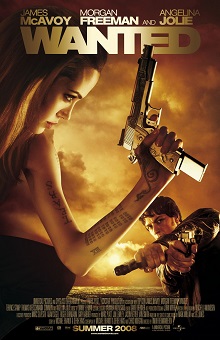
This is for John Mark.
Imagine a group of twenty-something men -- men of my generation -- in a room together talking about their favorite things. Video games, a hot chick in leather (but not too much), stuff blowing up.
Then imagine this group of men put all of their favorite things in a movie. Sound of Music, I assure you, it would not be.
Instead, you'd get what is called a summer blockbuster movie. And if one of the men in that hypothetical room vaguely remembers Greek mythology from high school, you'd get the movie Wanted. The only way to describe it is an excess -- and I do mean excess -- of all things a post-adolescent boy would consider "badass." It's got Angelina Jolie shooting things, Morgan Freeman being the wise godlike figure, and a Fight Club set-up with the main character (played by James McAvoy, who really can do better) living a zombie-like existence until he is rescued to a group of elite fighters who spend about as much screen time beating each other up as training as killing targets. Plus, most of the shots work perfectly as a video game set up. What more could a boy want? A Rocky reference or two? Oh, they are there, too (mmm . . . meat on hooks . . .). Oh, and throw in a little bit of the Matrix for good measure -- those special effects were cool, right? And everyone's mind was blown by the whole existential "There is no spoon" discussion. Might as well throw in some fate/pre-determination stuff here, too.
It is a movie that revels in excess, and this can be entertaining, but only if you've already got a high tolerance for that sort of thing. The combination of influences was a merry jumble, if somewhat overwhelming, and I must admit I enjoyed the unselfconscious stupidity of throwing all those movie and pseudo-philosophical references into a grab bag of ideas and visuals. However, if you, like me, are not used to playing Grand Theft Auto for hours on end, sitting through so many fight scenes with frenetic editing and pounding hard rock soundtrack becomes a little numbing to the senses. I'd say I liked about half of the movie and for the rest worried about an impending headache.
My friend's favorite part of the movie was when our "hero" -- I really hate calling him that -- hits someone with a keyboard. Keys fly off (as well as a tooth), and they magically align into two angry words I won't type here, but suffice it to say that the second one was "you."
This effect was clever, and somewhat funny, but I think it works a lot better in its original comic book (or is it "graphic novel"?) form. I haven't read any of the original source, but I suspect a form that uses the written word doesn't have as much trouble having to explain if the words spelled out in a picture are actually spelled out in that picture's world. When a superhero hits the villain with a POW! written in a starburst, I've never thought about where that starburst came from. But when a bullet said the word "Goodbye" in this movie, I was distracted from the moment by the nagging question, "Is that actually written there? Does it appear magically, or was it already on the bullet when it was loaded, therefore not having any specific significance in this situation?" Some parts of the comic book medium just don't work as well in a movie.
I suppose I could summarize the plot a bit, but it doesn't really matter. James McAvoy is a sadsack temp who discovers his father was part of an elite group of assassins called the Fraternity. He gets recruited, nominally to kill the man who killed his father, and quickly learns how to fight, get bloody, and curve bullets. Apparently the Fraternity has a couple of magical items in its possession. First, a magical loom's threads tell the Fraternity who should be killed (imagine the Fraternity to the be the Three Fates with guns). Second, magical paraffin wax baths serve the useful plot device of helping the assassins recover from their rough-and-tumble ways.
James McAvoy's character quickly becomes as badass as the rest of the gang, and then surpasses them in badassness when he discovers a secret of the Fraternity and decides to Do What Is Right -- which involves a lot of blowing stuff up. In fact, one of his old jackass friends, after being beaten up by him, intones in an awed voice that the friend he once took advantage of is now "the man." You can almost hear the voices of those young men writing the script bowing down to the awesomeness of the character they have just created.
Unfortunately no one has told those young writers that trying really hard to be badass doesn't actually make someone badass. You have to be a little cooler, a little more sleek, a little more aloof. I can't believe I'm about to say this, but give me Keanu and the half-baked mysticism of the Matrix any day.
1.5 stars
19.7.07
3 lbs
3lbs, the television show named after the three-pound organ that is the human brain, aspired to be complex, intriguing, and provoking. Achieving such a goal should have come naturally; the show revolves around two world-class brain surgeons and one neurologist and the cases they encounter. Instead, it got cancelled in the US after 3 weeks, leaving five more episodes unaired. But, being in Bangladesh, I get to see all of them on the Hallmark channel, and I've seen four so far.
In a House-like format, each episode involves a case or two that include bizarre, medical-mystery-meets-medical-journalism symptoms and results. Of the episodes I've seen, each case highlights the enigma of the brain -- is it "wires in a box," as one character claims, or is the human brain (or the human pysche) more elusive than that?
The most natural tension of neuroscience is, of course, what makes us human, which is mirrored nicely in the science/religion dichotomy that crops up quite frequently in the first few episodes of the first season. This could make for a fascinating, unspoken dialogue in the series, a tension that keeps the subject of the show relevant and thought-provoking, rather than simply the fodder to give the characters something to do in addition to their more trite interpersonal interactions.
Instead, 3 lbs makes that dialogue spoken between the characters, which is somewhat necessary to explain the science and philosophy, but makes every character a little too much like "Exposition Boy!". The show tries too hard to be both scientific and poetic, and ends up failing at both. The science goes by fast, but not fast enough to think that these people know what they're talking about, and also not fast enough for me miss the fact that some of the science sounds surprisingly suspect. And in an attempt to be mystical and poetic about the brain, the show's creators establish bizarre visual tropes in each episode to represent the mental effects of the brain damage at issue in the show. The special effects are generally surreal or dada-ist (my favorite so far has been the hanging lights in the hospital corridors acutally being upside-down dandelions that have gone to seed), but they disappear too quickly for the audience to be able to process them or figure out how they fit into the reality of the show. Most annoyingly, it's often unclear who "sees" these visual effects -- sometimes they are clearly the experience of the patient, but often they seem to be created by the mind's eye of the cynical doctor (played by Stanley Tucci).
With these problem, 3lbs fails to be a stellar show. However, the three main actors prop up the show enough to keep it decent. Stanley Tucci plays the star surgeon, a brilliant but cynical, Dr. House-like character who doesn't like people that much except as brains to tinker with. Indira Varma plays the neurologist, who's much more new age-y and loves patients and people (think Dr. Cameron in House), and Mark Feuerstein plays the new guy who is Tucci's sidekick and is supposed to represent the wise and happy medium. All three actors are likeable, and try their best to overcome the cheesy, formulaic plots and interactions with "unsolved scientific questions." I for one am certainly willing to put up with a certain amount of plot stupidity for Stanley Tucci and Mark Feuerstein, though for completely different reasons. One's an amazing actor, and the other, well, is just fun to watch, if you know what I mean.... In the end, though, with better medical dramas on television (especially House, M.D., which has practically the same formula and characters) it's not surprising this show got cancelled so fast.
1.5 stars
In a House-like format, each episode involves a case or two that include bizarre, medical-mystery-meets-medical-journalism symptoms and results. Of the episodes I've seen, each case highlights the enigma of the brain -- is it "wires in a box," as one character claims, or is the human brain (or the human pysche) more elusive than that?
The most natural tension of neuroscience is, of course, what makes us human, which is mirrored nicely in the science/religion dichotomy that crops up quite frequently in the first few episodes of the first season. This could make for a fascinating, unspoken dialogue in the series, a tension that keeps the subject of the show relevant and thought-provoking, rather than simply the fodder to give the characters something to do in addition to their more trite interpersonal interactions.
Instead, 3 lbs makes that dialogue spoken between the characters, which is somewhat necessary to explain the science and philosophy, but makes every character a little too much like "Exposition Boy!". The show tries too hard to be both scientific and poetic, and ends up failing at both. The science goes by fast, but not fast enough to think that these people know what they're talking about, and also not fast enough for me miss the fact that some of the science sounds surprisingly suspect. And in an attempt to be mystical and poetic about the brain, the show's creators establish bizarre visual tropes in each episode to represent the mental effects of the brain damage at issue in the show. The special effects are generally surreal or dada-ist (my favorite so far has been the hanging lights in the hospital corridors acutally being upside-down dandelions that have gone to seed), but they disappear too quickly for the audience to be able to process them or figure out how they fit into the reality of the show. Most annoyingly, it's often unclear who "sees" these visual effects -- sometimes they are clearly the experience of the patient, but often they seem to be created by the mind's eye of the cynical doctor (played by Stanley Tucci).
With these problem, 3lbs fails to be a stellar show. However, the three main actors prop up the show enough to keep it decent. Stanley Tucci plays the star surgeon, a brilliant but cynical, Dr. House-like character who doesn't like people that much except as brains to tinker with. Indira Varma plays the neurologist, who's much more new age-y and loves patients and people (think Dr. Cameron in House), and Mark Feuerstein plays the new guy who is Tucci's sidekick and is supposed to represent the wise and happy medium. All three actors are likeable, and try their best to overcome the cheesy, formulaic plots and interactions with "unsolved scientific questions." I for one am certainly willing to put up with a certain amount of plot stupidity for Stanley Tucci and Mark Feuerstein, though for completely different reasons. One's an amazing actor, and the other, well, is just fun to watch, if you know what I mean.... In the end, though, with better medical dramas on television (especially House, M.D., which has practically the same formula and characters) it's not surprising this show got cancelled so fast.
1.5 stars
17.5.07
Mr. Deeds Goes To Town
 There is such a thing as too much of a good thing.
Call me a sap, but there’s something about starry-eyed idealism mixed with screwball comedy that makes me a sucker for so many movies directed by the great Frank Capra: It’s a Wonderful Life, Mr. Smith Goes to Washington, You Can’t Take it With You, It Happened One Night, Arsenic and Old Lace and even Meet John Doe. With this kind of background love of a director’s work, I eagerly anticipating watching Mr. Deeds Goes to Town, another Frank Capra film.
The plot is ripe for Caprian dramatics. Made in the middle of the Great Depression, the movie weaves its fantasy around the issues of the times: Mr. Deeds, an unassuming small town man played by Gary Cooper, inherits an absurdly large fortune, and goes to New York to figure out what to do with his money. He falls for an undercover female reporter who writes stories making fun of him until she (of course) falls for him, too. He then meets a desperate and poor farmer, and Mr. Deeds decides he wants to spend his money to fund farms for thousands of poor and homeless families. This abrupt and altruistic decision causes the moneygrubbers surrounding Mr. Deeds to claim that he is insane and his fortune should be taken away from him, and the movie culminates in a sanity hearing where all characters can make their rousing speeches to the judge and the movie audience.
Such trite plots usually provide Capra an excellent platform on which to direct feel-good movies that amount to character studies of the American Everyman. Like Mr. Smith in Mr. Smith Goes to Washington, Mr. Deeds is supposed to represent the noble average American, and represents the resilience of such Men through the Great Depression. The movie even won Capra Best Director in the 1936 Academy Awards, which I think can only be a testament to the era's sentimentality to such a message, because, frankly, the movie itself wasn't that good.
I really wanted to like Mr. Deeds and his movie, but the movie just didn’t age well. Mr. Deeds comes off more as a spoiled brute who punches people and silently sulks, rather than an unspoiled individualist who stands up and speaks out against corruption. What’s more, he also rotates between naïve country bumpkin and hardnosed businessman just about every five minutes. While Gary Cooper can carry both Mr. Deeds personas with aplomb, the rapid switches are almost too much to take, creating an almost dizzying affect for a modern audience. Mr. Deeds goes from sympathetic listener one moment to domineering authoritarian kicking the speaker out the door the next moment. We go from a goofy-looking Gary Cooper easily duped by Jean Arthur’s female reporter to scowling Cooper sucker punching a bunch of elite poets. What’s going on here? This is the ideal American? I certainly hope not.
In sum, this movie was a mixure of saccharin and soap-boxing combined with ridiculous characters. Now, that would generally describe any Frank Capra movie, but in Mr. Deeds Goes to Town, each element was so extreme that even I couldn't stand it.
20.7.06
Me and You and Everyone We Know
 I’ll admit it: I read movie critics’ reviews to decide whether to watch movies, especially A. O. Scott of the New York Times. So when he, along with seemingly every critic with a word processor, fell in love with Miranda July’s first feature film, Me and You and Everyone We Know, I was ready to like it. In fact, I was eager to like it – so much so that I sat through the entire movie struggling to figure out what, exactly, it was that I was supposed to like.
Miranda July, who wrote, directed, and starred in the film, is first and foremost a performance artist, and to a large degree her debut film valiantly and stubbornly refuses to comply with the conventions of feature films, instead relying on her own background to create the world of film. This creates some very magical moments, all underscored by Mike Andrews’ beautifully simple and whimsical soundtrack. Certain scenes are more like poems than scenes in a movie: a walk down a street becomes a metaphor for a couple’s relationship, a ten year old girl uses her bedroom ceiling as the blank page to blueprint her future kitchen, and a man tries to hide a framed print of a bird – a relic of his unhappy past – by wedging it into a tree.
Unfortunately, these moments do not come together with the charm that they individually suggest. While I am all for films creating worlds and storytelling paces that are not “realistic,” films (and, indeed, all art) requires some real connection between the audience and the characters or plot. The loose story noncommittally wanders between small plots involving an amateur performance artist, a shoe salesman, and their family and friends, but we never really get to see any story long enough to really understand it. Worse still, we cannot care about characters so utterly removed from humanity that they have none of the same worries and fears as normal human beings. In the world of Me and You and Everyone We Know, people do not worry about conversations with strangers or being too forward when first meeting someone. They do not worry about a child who obsessively buys kitchen and home supplies for her hope chest. They do not worry about the fact that sexually explicit messages taped to a window facing a bus stop might be read by more than the two teenage girls for whom the messages are intended. Somehow, in this world, everyone is unconcerned for the safety and health of a man who pours lighter fluid on his hand and ignites it in front of his sons. Nor does anyone seems to notice or be disturbed by a seven year old boy who wanders into an online chat room and ends up having multiple conversations I will not describe here. Instead, all of these incidents are supposed to be somehow endearing and indicative of inherent worth.
Instead of exploring her characters, Ms. July relies on the crutch that too many modern artists lean on: being different without deciding why it matters to be different. Instead, her work seems to proclaim that just being different makes it Important. Most critics seem to have fallen victim to this ploy, falling in love with this movie for no other reason than the fact that Ms. July uses a non-linear plot and doesn’t focus on character or plot or, indeed, much of anything. After all the critical attention this tactic acquired, a conscientious viewer might, like me, try to like the film because it claims to be Artistically Important.
And yet, I could never focus on the artistic techniques and merits of the film because I was too distracted by the fact that I didn’t care at all about the movie or the people it portrayed. Who cares if a film is artistically different if it doesn’t use those qualities to convey something more powerful: a message, a story, or maybe even a character’s revelation or two? The same critics who pan a blockbuster action film for not developing plot or character even if that film created new innovations in pyrotechnics or computer animation should have turned in a similar complaint for this film: all technique, but for no reason.
Me and You and Everyone We Know feels more like something you should be watching as an installation at your local museum, sitting on a large hard bench and pondering not only the film but the paint splotch helpfully named “Untitled No. 4” next to it. It is a noble idea to remind us not to pigeonhole the medium of film any more than we do the medium of paint or print. However, without any other purpose that breaking filmic conventions, this film ends up being more something the critics tell you you’re supposed to appreciate than something you can actually enjoy.
1 out of 4 stars (do I have to give it any stars?)
Subscribe to:
Posts (Atom)