OK, I promised an explanation of why I love Pushing Daisies. Now that the series is cancelled (only three more episodes to go!), it seems sad to write about it, but since I've been spending the last few days trying to convince my sister how amazing the show is, here I go:
The main premise of Pushing Daisies is a bit confusing, and I'm sure it was its demise. Ned is a pie maker who can raise the dead with his touch -- this includes people, animals, and plants. If he touches it again, though, it dies. Plus, if he raises something from the dead for more than one minute, something else of equal "value" dies (e.g., a person for a person, or a plant for a plant). The words make it sound hokey and stupid, but the result is much more magical.
The first magical thing is that Ned's girlfriend is someone he raised from the dead. This means he can never touch her. My sister hates this, but I think it's amazing. First of all, it's very old fashioned. I'm reminded of the censorship days of movies and television, when love stories had to be chaste even if sexually charged -- Ned and Charlotte (aka Chuck) even sleep in separate twin beds with a nightstand in between like all the sitcom couples of old.
Also, I'm pretty sure all romance is about not getting what you want. If you never get it, it's a tragedy. If you get delayed gratification, it's a comedy. Pushing Daisies pushes this definition and creates a tragicomedic relationship. Boy gets girl in once sense, but in another he doesn't (and never will).
The second magical thing is that death becomes malleable. One of my main gripes with modernity is we care so much about death -- we're so afraid of it. Maybe this is just my youth talking, but I'm not sure why we are so scared. Shows with death tend to try to drive this home, making death as sad and overwhelming and ugly as our society perceives it to be (see, e.g., House, every cop show ever, every mob show, even Six Feet Under). Pushing Daisies doesn't make light of death, but it isn't afraid of it, either. People die horrible deaths, but it's never gruesome. And since people can come back to life, but the story doesn't have time for them to go into shock or horror about being dead, it's nice to see characters who don't have a problem with being dead, either. (This reminds me of other Bryan Fuller shows, such as Dead Like Me, which was also brilliant).
The third magical thing is Kristin Chenoweth. She's just amazing -- a funny little spitfire who would be the grounding normal character of the series, if she weren't so quirky herself. In fact, all of the characters are quirky. It's a bit forced at times, but it's nice to know that people don't fit into neat categories -- the hardboiled detective also knits and makes pop-up books, and the shut-in aunts are former synchronized swimmers.
Finally, I love the production design of the show -- I absolutely love the costumes, which tend to be all over the place from 40s to 70s, but always are amazing. I love the visual jokes (Chenoweth's character is named Olive, and she recently got a rain slicker with olives on it, and Emerson Cod the detective's slicker had fish on it). And I love the myriad movie visual references, especially since they are so Hitchcock-heavy (The Birds, Vertigo, Psycho and Suspicion have all been copied. I'm really hoping for the key scene from Notorious before the end of the series, but that may be asking for too much).
Sure, there are faults with the show. The strange premise is often bent or broken -- some things come alive and others don't, but there's no real rhyme or reason to it (dead leaves but not wood? dead fruit but not other baking supplies?). There are a couple of camera and editing problems -- a visual joke involving a one-eyed aunt in the pilot episode was done backwards, and it drives me nuts every time I see it.
But its faults are easily forgotten when weighed against the fact that there's really nothing else like it. For people who like movies and old-fashioned TV more than reality TV or procedural dramas, this is a wonderful show. Plus, Lee Pace is hot.

Showing posts with label romance. Show all posts
Showing posts with label romance. Show all posts

26.3.08
Sense and Sensibility
In honor of my friends who are having a Jane Austen marathon as I post this:
 With unfortunate frequency I find myself frustrated at the lack of new movies. I don’t mean there aren’t new releases every week, but rather that they seem to be simple repackaging of the same stories over and over. Now, I know that there are only 36 situations in stories , but at least the story should look new at first gloss, right? Instead, I seem to see constant remakes and sequels of older movies, comic books, novels, even biographies – all of which were better the first time around. Just think of the big movies of summer 2007: Spiderman 3 (a sequel of a comic book adaptation); 28 Weeks Later (sequel); Shrek the Third (sequel of a pop culture/fairy tale mashup); Pirates of the Caribbean, At World’s End (sequel); Ocean’s Thirteen (sequel of a remake). We got another Die Hard movie, and another Harry Potter adaptation. Hairspray was a movie version of a stage production. Even the Simpsons movie was basically just a full-length version of a 22-minute regular episode. Of course, there were a couple new movies (like the brilliant Ratatouille), but adaptations and sequels seem to have taken over the big screen.
I understand the business reasoning behind such endeavors – it takes less work to get people to come to a movie they already know. I mean, Harry Potter movies practically sell themselves just by the title. Even ostensibly new movies get sold as “from the makers of . . .” and even Ratatouille got billed by its connections to prior successes with the Pixar label.
But every once in a long while a beautiful adaptation comes along, making me succumb to old stories. Surprisingly enough, three of my favorite adaptations come from Jane Austen: Clueless (an adaptation of Emma), Pride and Prejudice (not the A&E version, the Keira Knightly version, believe it or not), and the 1995 Sense and Sensibility, adapted by Emma Thompson. My plea to the writers of the many many adaptations to come, if producers remain as risk-averse as they have been lately: learn from Ms. Thompson and Ang Lee, the director (yes, of Brokeback Mountain fame).
The key to a wonderful adaptation is to figure out the essence of the story without feeling burdened by it. A two hour movie is basically equivalent to a novella in length – you just aren’t going to be able to have the plot and character development of a full novel. Don’t even try. The only times it’s ever worked is the A&E Pride and Prejudice marathon and Ken Branagh’s endless uncut four-hour Hamlet. I must admit that though I love Jane Austen stories, the prose gets incredibly cumbersome, which is perhaps why adaptations of her work tend to fare relatively well. No movie is going to take twenty minutes analyzing the quality of the garden hedges, so let’s just cut that wholesale.
Second, feel free to add scenes, but only if you can understand the material enough to be seemless. Apparently, many people have written Emma Thompson or told her that they loved that she kept their favorite part of the book in the movie – a scene about the little girl Margaret being coaxed out of hiding by Elinor and Mr. Ferras pretending to not know any geography. But this scene isn’t in the book. It just fits so well that people thought it was.
Third, remember your medium! My favorite part about the movie is that it’s so clearly a movie. Ang Lee does amazing things with his shots, covering in seconds what takes pages and pages in a book. I’ve seen the movie many times, and every time give a little shudder of delight with the abrupt cutting between Elinor and Mr. Ferras when they are awkwardly talking in the stables. Those cuts make the scene hilarious in a way that even the best comedic adaptation couldn’t do on its own. Mr. Lee also uses the English landscape to set the tone of a scene in a way that would make Ms. Austen proud – one scene, for example, brilliantly uses a long interior shot allows the audience to see the wind rustling the cloaks by the door to create a sense of expectation and foreboding.
Fourth, casting casting casting. The cast in Sense and Sensibility is basically perfect. Costume dramas are hard to cast, as the horrible miscasting of Keanu Reeves in another Emma Thompson movie makes clear. You have to get people who are comfortable with language, and who make sense for the parts. If there’s every a place to typecast, this is it, and Sense and Sensibility does so with a loveable but inept Hugh Grant as Mr. Ferras (does he ever play any other part) and Alan Rickman as the kind but brooding Colonel Brandon. Kate Winslet plays young and impetuous Marianne well, which probably was less playing and more just being a nineteen-year old who lied about her age to get the part. If the original source uses physical attributes to display character traits, by all means do so in your casting here, as the rotund and ridiculous Mrs. Jennings (played by Elizabeth Spriggs) and the haughty and pointy-nosed Fanny Dashwood (Harriet Walter) exhibit.
All in all, this adapation is everything an adaptation should be – great story that’s made into an equally great movie, with a brilliant cast (some of whom got their big breaks here) and a brilliant script and brilliant director. 4 stars.
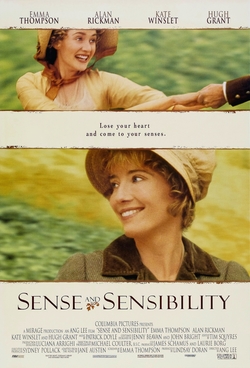 With unfortunate frequency I find myself frustrated at the lack of new movies. I don’t mean there aren’t new releases every week, but rather that they seem to be simple repackaging of the same stories over and over. Now, I know that there are only 36 situations in stories , but at least the story should look new at first gloss, right? Instead, I seem to see constant remakes and sequels of older movies, comic books, novels, even biographies – all of which were better the first time around. Just think of the big movies of summer 2007: Spiderman 3 (a sequel of a comic book adaptation); 28 Weeks Later (sequel); Shrek the Third (sequel of a pop culture/fairy tale mashup); Pirates of the Caribbean, At World’s End (sequel); Ocean’s Thirteen (sequel of a remake). We got another Die Hard movie, and another Harry Potter adaptation. Hairspray was a movie version of a stage production. Even the Simpsons movie was basically just a full-length version of a 22-minute regular episode. Of course, there were a couple new movies (like the brilliant Ratatouille), but adaptations and sequels seem to have taken over the big screen.
I understand the business reasoning behind such endeavors – it takes less work to get people to come to a movie they already know. I mean, Harry Potter movies practically sell themselves just by the title. Even ostensibly new movies get sold as “from the makers of . . .” and even Ratatouille got billed by its connections to prior successes with the Pixar label.
But every once in a long while a beautiful adaptation comes along, making me succumb to old stories. Surprisingly enough, three of my favorite adaptations come from Jane Austen: Clueless (an adaptation of Emma), Pride and Prejudice (not the A&E version, the Keira Knightly version, believe it or not), and the 1995 Sense and Sensibility, adapted by Emma Thompson. My plea to the writers of the many many adaptations to come, if producers remain as risk-averse as they have been lately: learn from Ms. Thompson and Ang Lee, the director (yes, of Brokeback Mountain fame).
The key to a wonderful adaptation is to figure out the essence of the story without feeling burdened by it. A two hour movie is basically equivalent to a novella in length – you just aren’t going to be able to have the plot and character development of a full novel. Don’t even try. The only times it’s ever worked is the A&E Pride and Prejudice marathon and Ken Branagh’s endless uncut four-hour Hamlet. I must admit that though I love Jane Austen stories, the prose gets incredibly cumbersome, which is perhaps why adaptations of her work tend to fare relatively well. No movie is going to take twenty minutes analyzing the quality of the garden hedges, so let’s just cut that wholesale.
Second, feel free to add scenes, but only if you can understand the material enough to be seemless. Apparently, many people have written Emma Thompson or told her that they loved that she kept their favorite part of the book in the movie – a scene about the little girl Margaret being coaxed out of hiding by Elinor and Mr. Ferras pretending to not know any geography. But this scene isn’t in the book. It just fits so well that people thought it was.
Third, remember your medium! My favorite part about the movie is that it’s so clearly a movie. Ang Lee does amazing things with his shots, covering in seconds what takes pages and pages in a book. I’ve seen the movie many times, and every time give a little shudder of delight with the abrupt cutting between Elinor and Mr. Ferras when they are awkwardly talking in the stables. Those cuts make the scene hilarious in a way that even the best comedic adaptation couldn’t do on its own. Mr. Lee also uses the English landscape to set the tone of a scene in a way that would make Ms. Austen proud – one scene, for example, brilliantly uses a long interior shot allows the audience to see the wind rustling the cloaks by the door to create a sense of expectation and foreboding.
Fourth, casting casting casting. The cast in Sense and Sensibility is basically perfect. Costume dramas are hard to cast, as the horrible miscasting of Keanu Reeves in another Emma Thompson movie makes clear. You have to get people who are comfortable with language, and who make sense for the parts. If there’s every a place to typecast, this is it, and Sense and Sensibility does so with a loveable but inept Hugh Grant as Mr. Ferras (does he ever play any other part) and Alan Rickman as the kind but brooding Colonel Brandon. Kate Winslet plays young and impetuous Marianne well, which probably was less playing and more just being a nineteen-year old who lied about her age to get the part. If the original source uses physical attributes to display character traits, by all means do so in your casting here, as the rotund and ridiculous Mrs. Jennings (played by Elizabeth Spriggs) and the haughty and pointy-nosed Fanny Dashwood (Harriet Walter) exhibit.
All in all, this adapation is everything an adaptation should be – great story that’s made into an equally great movie, with a brilliant cast (some of whom got their big breaks here) and a brilliant script and brilliant director. 4 stars.
17.5.07
Mr. Deeds Goes To Town
 There is such a thing as too much of a good thing.
Call me a sap, but there’s something about starry-eyed idealism mixed with screwball comedy that makes me a sucker for so many movies directed by the great Frank Capra: It’s a Wonderful Life, Mr. Smith Goes to Washington, You Can’t Take it With You, It Happened One Night, Arsenic and Old Lace and even Meet John Doe. With this kind of background love of a director’s work, I eagerly anticipating watching Mr. Deeds Goes to Town, another Frank Capra film.
The plot is ripe for Caprian dramatics. Made in the middle of the Great Depression, the movie weaves its fantasy around the issues of the times: Mr. Deeds, an unassuming small town man played by Gary Cooper, inherits an absurdly large fortune, and goes to New York to figure out what to do with his money. He falls for an undercover female reporter who writes stories making fun of him until she (of course) falls for him, too. He then meets a desperate and poor farmer, and Mr. Deeds decides he wants to spend his money to fund farms for thousands of poor and homeless families. This abrupt and altruistic decision causes the moneygrubbers surrounding Mr. Deeds to claim that he is insane and his fortune should be taken away from him, and the movie culminates in a sanity hearing where all characters can make their rousing speeches to the judge and the movie audience.
Such trite plots usually provide Capra an excellent platform on which to direct feel-good movies that amount to character studies of the American Everyman. Like Mr. Smith in Mr. Smith Goes to Washington, Mr. Deeds is supposed to represent the noble average American, and represents the resilience of such Men through the Great Depression. The movie even won Capra Best Director in the 1936 Academy Awards, which I think can only be a testament to the era's sentimentality to such a message, because, frankly, the movie itself wasn't that good.
I really wanted to like Mr. Deeds and his movie, but the movie just didn’t age well. Mr. Deeds comes off more as a spoiled brute who punches people and silently sulks, rather than an unspoiled individualist who stands up and speaks out against corruption. What’s more, he also rotates between naïve country bumpkin and hardnosed businessman just about every five minutes. While Gary Cooper can carry both Mr. Deeds personas with aplomb, the rapid switches are almost too much to take, creating an almost dizzying affect for a modern audience. Mr. Deeds goes from sympathetic listener one moment to domineering authoritarian kicking the speaker out the door the next moment. We go from a goofy-looking Gary Cooper easily duped by Jean Arthur’s female reporter to scowling Cooper sucker punching a bunch of elite poets. What’s going on here? This is the ideal American? I certainly hope not.
In sum, this movie was a mixure of saccharin and soap-boxing combined with ridiculous characters. Now, that would generally describe any Frank Capra movie, but in Mr. Deeds Goes to Town, each element was so extreme that even I couldn't stand it.
Subscribe to:
Posts (Atom)