Back in high school, one of my friends told me I should watch this movie, but I kept putting it off because the premise seemed strange (see below). I understand why my friend thought I would like To Be of Not To Be: I love Shakespeare. I love 40s comedies. And (until this movie) I particularly like the 40s director Ernst Lubitsch, who directed one of my favorite movies, Ninotchka, as well as The Shop Around the Corner, the sweet little movie on which You've Got Mail was based. So I'm a bit sad to report that To Be or Not To Be actually creeped me out more than entertained me. I don't think it means to be a black comedy, but this is by far one of the darkest I've seen.
Don't get me wrong. The actors are great. Jack Benny is very funny, and Carole Lombard is the definition of a star: luminescent and radiant. But I just couldn't get over the fact of this movie: a 1942 film about the Nazi occupation of Poland. Basically, the story revolves around a Polish theater troupe in Warsaw that gets sucked into high espionage when a star struck young bomber pilot in England accidentally asks a German spy to get a message to the woman he loves -- actress Maria Tura, played by Carole Lombard. The pilot finds out that the spy has information that will destroy the Polish Underground, along with all of the Resistance movement in Eastern Europe. And so he flies back to Poland to intercept the spy. In the process, Maria Tura, her hammish actor husband (played by Jack Benny), and the rest of the troupe go through hijinx galore to save Poland, the Resistance, and their own skins. Jack Benny wears a false beard and losing a mustache out the window of a car, while Carole Lombard seduces no less than three Gestapo officials within the span of 24 hours. There's a comedy routine with a corpse. A bit player dresses up as Hitler with a little mustache and fools about two dozen Gestapo guards into following him and deserting the real Hitler. Seriously, folks??
The hardest part about this movie is that, because it was made in 1942, it couldn't give a conclusive ending. Who knew who was really going to win? Instead, a few good people make it out of mainland Europe and on a plane to England. Not exactly a triumphant ending. I'm sure Lubitsch -- a German-born Jew -- could not have thought that comedy alone could mask the uncomfortable task of making a movie about the Polish occupation while Poland was still occupied. Several times throughout the movie, a bit player in the troupe (played by one of my favorite Lubitsch regulars, Felix Bressart) who dreams one day of playing Shylock in The Merchant of Venice keeps reciting the "If you prick us, do we not bleed?" speech. It's always a poignant speech, and Lubitsch lets its emotional weight come through each time, right before cutting away to more slapstick. It's a strange juxtaposition that echoes the even stranger juxtaposition of the movie itself, which played in theaters along with news reels about the realities of concentration camps and the war in Europe. The thought of this movie being made when the outcome of World War II was still uncertain is flabbergasting to me -- the movie is incredibly brave to treat the Nazis with such derision as well as humor, but also massively strange and unsettling if you didn't know the third act would end out all right, as it were.
In the end, I could never get over the oddity of the movie to actually enjoy it. Slapstick comedies are supposed to be heart-warming, or escapist, or something, not awkward and macabre as this one is. When it's ill-timed, laughter is not the best medicine.
2 stars -- good but falling far short of delightful.

Showing posts with label comedy. Show all posts
Showing posts with label comedy. Show all posts
11.2.10

21.1.10
Eep! It's 2010!
I can't believe I haven't posted in two months! Time does get away, doesn't it? It's particularly sad because I've watched a bunch of movies and even read a few books in the last couple of months. And if I don't write down my thoughts, there's a chance I'll forget I've even seen something. As happened just this week when I told a coworker I hadn't seen Can't Hardly Wait. No wait. I have. Oh, sure, yeah, I thought it was *really* good -- can't you tell what a lasting impression it made?
So, because I'm lazy, but still feel guilty that I haven't posted yet in 2010, I'll just lift a few of my short Netflix reviews:
The Dress Code (2000): The writers here must have thought quirkiness equals character, so there's a lot of the former and little of the latter. But the actors make up for it and deliver wonderfully nuanced performances that only hint at the depths of the people portrayed. The end felt a little forced, but I didnt care by that point -- I was too charmed by all the actors, from Alex Linz (the little boy) and Stacey Halprin (the mother) to the big name stars. All in all, a nice little story. If you like this movie, I also recommend Saint Ralph. Its in a similar vein, and I liked it much more than this one. 2 stars.
Easy Virtue: Where is the Noel Coward wit? It's there, but it's hidden, and I found myself wanting more brandishing of that wit than faux-20s music and overly staged sets. There were a few really good moments, but they're in the preview. This one barely earns its three stars, but Kristin Scott Thomas bumps it up a notch. She is the one razor sharp character among a pile of dull blades. And without equal blades, a jousting contest is just not that interesting. And to top it all off, I wouldn't actually classify this as "romantic comedy," which is clearly what the studio is going for. Just look at who they cast -- I thought Colin Firth *meant* sappy romantic comedy! Plus, they totally sell the happy-go-lucky side of the movie in the trailer, product description, and even classification for Netflix. (Actually, I don't know if the studio suggests the classification, or if Netflix does that. But whoever did it, it's misleading.) This isn't Oscar Wilde and it isn't An Ideal Husband -- not exactly a happy ending here. 1.5 stars.
Two Brothers and a Bride: I was surprised how much I liked this movie. Basically, it's about two brothers who run a farm who go to Russia to find a wife to take care of them after their mother dies. David Arquette and Tim Blake Nelson star, along with Emily Mortimer as a journalist in Russia who starts following them around for her documentary on mail-order brides. Given the premise, it could have come out very preachy ("Bad human-trafficking-type business!") or misogynistic ("Ha-ha! Look at the funny desperate Russian women, or the silly feminists!") or make cruel fun of two farm boys ("Wow they are such hicks, and stupid, too, for being unable to take care of themselves without their mother"). Instead, it is a small but lovable movie that refuses to condemn any of the characters, even as it does recognize the ridiculous in almost all of them. Plus, you get the pleasure of very good performances by Mortimer, Arquette, and Nelson. Not a must-see, but a nice change of pace from your typical meet-cute romcoms. 2 stars.
21.5.09

2.5.09
Unusually Smart David Mitchell
I absolutely love David Mitchell -- something about smart British funny guys I guess. Anyway, I found this to be particularly topical given the number of end-of-year black tie events I've had to go to recently. Geez, guys have it easy. The dress code is even named after how easy it is for them.
23.4.09
If only labs were really like this . . .
What do you get when you mix The Village People with a bio and chem research supplier?
A very weird music video:
(thanks, L. you made my evening.)
A very weird music video:
(thanks, L. you made my evening.)
17.4.09
Pseudo-Science drives me nuts
Hilarious commentary by Sarah Haskins on stupid skin care commercials using "sciency" words and pictures to sell things:
(yes, it's from February, but I just started going through archives)
(yes, it's from February, but I just started going through archives)
23.3.09
Ghost Town

Most of the time, if I say the first twenty minutes of a film were the best, and it all went downhill from there, I mean that the movie was bad. Not so here. Ghost Town started at such a high point that downhill is still pretty good. The first twenty minutes are some of the funniest I have ever seen – somehow even the opening credits of dental equipment were funny to me. (Why are plaster teeth molds funny? Not sure, but they are.) Those first twenty minutes confirm for me that Ricky Gervais may be the funniest man alive. His plays a misanthropic dentist, who seems to like his profession because it means he can stuff people’s mouths with cotton when he’s tired of listening to them. Any introvert will cringe with recognition at his desire to avoid human contact to the point of being rude. (Really, who hasn’t let those elevator doors close so you don’t have to ride with someone?)
Basically, Gervais’s character, Bertram Pincus, can see dead people because he “dies” for seven minutes during a routine colonoscopy. His discovery of this ability, and the reason for it, are truly brilliant, and Kristen Wiig (of SNL) has never been as hilarious as she is playing the surgeon who operated on him. Greg Kinnear plays Frank Herlihy, one of these ghosts, and he somehow hits a perfect note of charming and sleazy. Frank claims to have unfinished business that consists of breaking up his widow’s impending marriage, and annoys Bertram until he agrees to help. Of course, in so doing, Bertram ends up falling in love with the wife (Tea Leoni).
Thus begins the second part of the story, which is slightly less funny than the first part. Pincus cracks jokes with the widow, and Gervais is a genuinely good joke teller. He’s funny, but it’s no longer as heartbreakingly hilarious. Misanthropic avoidance of people was better than cracking jokes about how funny Chinese names are.
The third and last part of the movie is the weakest, but it’s still satisfactory. In the end, you have to get rid of some of these ghosts, which means Bertram Pincus must eventually crack and be a passably good guy. While this isn’t necessarily a bad thing – I actually did want his character to grow, unlike Roger Ebert – the movie just folds and ties up loose ends. This leads to some saccharin moments, and the main “revelation” of the movie about the nature of ghosts isn’t actually that spectacular. But since we do hope for a happy ending, which is a hard note to hit in a story about dead people and misanthropes, the fact that it didn’t come off as totally unpalatable is pretty impressive.
But if you don’t like the sugary ending, and find yourself missing the brilliant acidity of Bertram Pincus before he had a change of heart, I suggest you do what I did: after watching, just go back and watch those first twenty minutes again.
23.12.08
Pushing Daisies (as promised)
OK, I promised an explanation of why I love Pushing Daisies. Now that the series is cancelled (only three more episodes to go!), it seems sad to write about it, but since I've been spending the last few days trying to convince my sister how amazing the show is, here I go:
The main premise of Pushing Daisies is a bit confusing, and I'm sure it was its demise. Ned is a pie maker who can raise the dead with his touch -- this includes people, animals, and plants. If he touches it again, though, it dies. Plus, if he raises something from the dead for more than one minute, something else of equal "value" dies (e.g., a person for a person, or a plant for a plant). The words make it sound hokey and stupid, but the result is much more magical.
The first magical thing is that Ned's girlfriend is someone he raised from the dead. This means he can never touch her. My sister hates this, but I think it's amazing. First of all, it's very old fashioned. I'm reminded of the censorship days of movies and television, when love stories had to be chaste even if sexually charged -- Ned and Charlotte (aka Chuck) even sleep in separate twin beds with a nightstand in between like all the sitcom couples of old.
Also, I'm pretty sure all romance is about not getting what you want. If you never get it, it's a tragedy. If you get delayed gratification, it's a comedy. Pushing Daisies pushes this definition and creates a tragicomedic relationship. Boy gets girl in once sense, but in another he doesn't (and never will).
The second magical thing is that death becomes malleable. One of my main gripes with modernity is we care so much about death -- we're so afraid of it. Maybe this is just my youth talking, but I'm not sure why we are so scared. Shows with death tend to try to drive this home, making death as sad and overwhelming and ugly as our society perceives it to be (see, e.g., House, every cop show ever, every mob show, even Six Feet Under). Pushing Daisies doesn't make light of death, but it isn't afraid of it, either. People die horrible deaths, but it's never gruesome. And since people can come back to life, but the story doesn't have time for them to go into shock or horror about being dead, it's nice to see characters who don't have a problem with being dead, either. (This reminds me of other Bryan Fuller shows, such as Dead Like Me, which was also brilliant).
The third magical thing is Kristin Chenoweth. She's just amazing -- a funny little spitfire who would be the grounding normal character of the series, if she weren't so quirky herself. In fact, all of the characters are quirky. It's a bit forced at times, but it's nice to know that people don't fit into neat categories -- the hardboiled detective also knits and makes pop-up books, and the shut-in aunts are former synchronized swimmers.
Finally, I love the production design of the show -- I absolutely love the costumes, which tend to be all over the place from 40s to 70s, but always are amazing. I love the visual jokes (Chenoweth's character is named Olive, and she recently got a rain slicker with olives on it, and Emerson Cod the detective's slicker had fish on it). And I love the myriad movie visual references, especially since they are so Hitchcock-heavy (The Birds, Vertigo, Psycho and Suspicion have all been copied. I'm really hoping for the key scene from Notorious before the end of the series, but that may be asking for too much).
Sure, there are faults with the show. The strange premise is often bent or broken -- some things come alive and others don't, but there's no real rhyme or reason to it (dead leaves but not wood? dead fruit but not other baking supplies?). There are a couple of camera and editing problems -- a visual joke involving a one-eyed aunt in the pilot episode was done backwards, and it drives me nuts every time I see it.
But its faults are easily forgotten when weighed against the fact that there's really nothing else like it. For people who like movies and old-fashioned TV more than reality TV or procedural dramas, this is a wonderful show. Plus, Lee Pace is hot.
22.6.08
Priceless
Another mini-review:
I came to this movie to watch Audrey Tatou, who I enjoyed so much in Amelie, and to relive Breakfast at Tiffany's, a brilliant and beautiful movie of which this is a loose adaptation. In the end, though, Ms. Tatou suffers from a script and direction that to some extent reduced her to a mannequin for all the expensive labels draped over her body. The best scenes are closeups of her, where she is actually allowed to act and remind of us her gamine quality rather than being forced to strut about in a manner very much like the women in Sex and the City. However, this movie still has wit and charm, and the minor characters are all perfect caricatures (especially the dog owners at the beginning of the movie). Most importantly, I absolutely fell in love with Gad Elmaleh, whose fumbling and awkwardness is subtle enough to reveal both charm and intelligence. I've read (but not yet seen) that he is even better in the Valet, but this was plenty good for me.
I came to this movie to watch Audrey Tatou, who I enjoyed so much in Amelie, and to relive Breakfast at Tiffany's, a brilliant and beautiful movie of which this is a loose adaptation. In the end, though, Ms. Tatou suffers from a script and direction that to some extent reduced her to a mannequin for all the expensive labels draped over her body. The best scenes are closeups of her, where she is actually allowed to act and remind of us her gamine quality rather than being forced to strut about in a manner very much like the women in Sex and the City. However, this movie still has wit and charm, and the minor characters are all perfect caricatures (especially the dog owners at the beginning of the movie). Most importantly, I absolutely fell in love with Gad Elmaleh, whose fumbling and awkwardness is subtle enough to reveal both charm and intelligence. I've read (but not yet seen) that he is even better in the Valet, but this was plenty good for me.
26.3.08
Sense and Sensibility
In honor of my friends who are having a Jane Austen marathon as I post this:
 With unfortunate frequency I find myself frustrated at the lack of new movies. I don’t mean there aren’t new releases every week, but rather that they seem to be simple repackaging of the same stories over and over. Now, I know that there are only 36 situations in stories , but at least the story should look new at first gloss, right? Instead, I seem to see constant remakes and sequels of older movies, comic books, novels, even biographies – all of which were better the first time around. Just think of the big movies of summer 2007: Spiderman 3 (a sequel of a comic book adaptation); 28 Weeks Later (sequel); Shrek the Third (sequel of a pop culture/fairy tale mashup); Pirates of the Caribbean, At World’s End (sequel); Ocean’s Thirteen (sequel of a remake). We got another Die Hard movie, and another Harry Potter adaptation. Hairspray was a movie version of a stage production. Even the Simpsons movie was basically just a full-length version of a 22-minute regular episode. Of course, there were a couple new movies (like the brilliant Ratatouille), but adaptations and sequels seem to have taken over the big screen.
I understand the business reasoning behind such endeavors – it takes less work to get people to come to a movie they already know. I mean, Harry Potter movies practically sell themselves just by the title. Even ostensibly new movies get sold as “from the makers of . . .” and even Ratatouille got billed by its connections to prior successes with the Pixar label.
But every once in a long while a beautiful adaptation comes along, making me succumb to old stories. Surprisingly enough, three of my favorite adaptations come from Jane Austen: Clueless (an adaptation of Emma), Pride and Prejudice (not the A&E version, the Keira Knightly version, believe it or not), and the 1995 Sense and Sensibility, adapted by Emma Thompson. My plea to the writers of the many many adaptations to come, if producers remain as risk-averse as they have been lately: learn from Ms. Thompson and Ang Lee, the director (yes, of Brokeback Mountain fame).
The key to a wonderful adaptation is to figure out the essence of the story without feeling burdened by it. A two hour movie is basically equivalent to a novella in length – you just aren’t going to be able to have the plot and character development of a full novel. Don’t even try. The only times it’s ever worked is the A&E Pride and Prejudice marathon and Ken Branagh’s endless uncut four-hour Hamlet. I must admit that though I love Jane Austen stories, the prose gets incredibly cumbersome, which is perhaps why adaptations of her work tend to fare relatively well. No movie is going to take twenty minutes analyzing the quality of the garden hedges, so let’s just cut that wholesale.
Second, feel free to add scenes, but only if you can understand the material enough to be seemless. Apparently, many people have written Emma Thompson or told her that they loved that she kept their favorite part of the book in the movie – a scene about the little girl Margaret being coaxed out of hiding by Elinor and Mr. Ferras pretending to not know any geography. But this scene isn’t in the book. It just fits so well that people thought it was.
Third, remember your medium! My favorite part about the movie is that it’s so clearly a movie. Ang Lee does amazing things with his shots, covering in seconds what takes pages and pages in a book. I’ve seen the movie many times, and every time give a little shudder of delight with the abrupt cutting between Elinor and Mr. Ferras when they are awkwardly talking in the stables. Those cuts make the scene hilarious in a way that even the best comedic adaptation couldn’t do on its own. Mr. Lee also uses the English landscape to set the tone of a scene in a way that would make Ms. Austen proud – one scene, for example, brilliantly uses a long interior shot allows the audience to see the wind rustling the cloaks by the door to create a sense of expectation and foreboding.
Fourth, casting casting casting. The cast in Sense and Sensibility is basically perfect. Costume dramas are hard to cast, as the horrible miscasting of Keanu Reeves in another Emma Thompson movie makes clear. You have to get people who are comfortable with language, and who make sense for the parts. If there’s every a place to typecast, this is it, and Sense and Sensibility does so with a loveable but inept Hugh Grant as Mr. Ferras (does he ever play any other part) and Alan Rickman as the kind but brooding Colonel Brandon. Kate Winslet plays young and impetuous Marianne well, which probably was less playing and more just being a nineteen-year old who lied about her age to get the part. If the original source uses physical attributes to display character traits, by all means do so in your casting here, as the rotund and ridiculous Mrs. Jennings (played by Elizabeth Spriggs) and the haughty and pointy-nosed Fanny Dashwood (Harriet Walter) exhibit.
All in all, this adapation is everything an adaptation should be – great story that’s made into an equally great movie, with a brilliant cast (some of whom got their big breaks here) and a brilliant script and brilliant director. 4 stars.
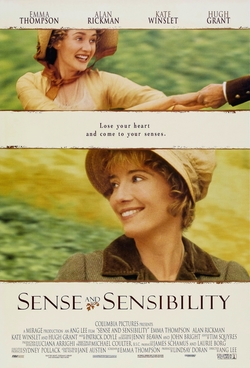 With unfortunate frequency I find myself frustrated at the lack of new movies. I don’t mean there aren’t new releases every week, but rather that they seem to be simple repackaging of the same stories over and over. Now, I know that there are only 36 situations in stories , but at least the story should look new at first gloss, right? Instead, I seem to see constant remakes and sequels of older movies, comic books, novels, even biographies – all of which were better the first time around. Just think of the big movies of summer 2007: Spiderman 3 (a sequel of a comic book adaptation); 28 Weeks Later (sequel); Shrek the Third (sequel of a pop culture/fairy tale mashup); Pirates of the Caribbean, At World’s End (sequel); Ocean’s Thirteen (sequel of a remake). We got another Die Hard movie, and another Harry Potter adaptation. Hairspray was a movie version of a stage production. Even the Simpsons movie was basically just a full-length version of a 22-minute regular episode. Of course, there were a couple new movies (like the brilliant Ratatouille), but adaptations and sequels seem to have taken over the big screen.
I understand the business reasoning behind such endeavors – it takes less work to get people to come to a movie they already know. I mean, Harry Potter movies practically sell themselves just by the title. Even ostensibly new movies get sold as “from the makers of . . .” and even Ratatouille got billed by its connections to prior successes with the Pixar label.
But every once in a long while a beautiful adaptation comes along, making me succumb to old stories. Surprisingly enough, three of my favorite adaptations come from Jane Austen: Clueless (an adaptation of Emma), Pride and Prejudice (not the A&E version, the Keira Knightly version, believe it or not), and the 1995 Sense and Sensibility, adapted by Emma Thompson. My plea to the writers of the many many adaptations to come, if producers remain as risk-averse as they have been lately: learn from Ms. Thompson and Ang Lee, the director (yes, of Brokeback Mountain fame).
The key to a wonderful adaptation is to figure out the essence of the story without feeling burdened by it. A two hour movie is basically equivalent to a novella in length – you just aren’t going to be able to have the plot and character development of a full novel. Don’t even try. The only times it’s ever worked is the A&E Pride and Prejudice marathon and Ken Branagh’s endless uncut four-hour Hamlet. I must admit that though I love Jane Austen stories, the prose gets incredibly cumbersome, which is perhaps why adaptations of her work tend to fare relatively well. No movie is going to take twenty minutes analyzing the quality of the garden hedges, so let’s just cut that wholesale.
Second, feel free to add scenes, but only if you can understand the material enough to be seemless. Apparently, many people have written Emma Thompson or told her that they loved that she kept their favorite part of the book in the movie – a scene about the little girl Margaret being coaxed out of hiding by Elinor and Mr. Ferras pretending to not know any geography. But this scene isn’t in the book. It just fits so well that people thought it was.
Third, remember your medium! My favorite part about the movie is that it’s so clearly a movie. Ang Lee does amazing things with his shots, covering in seconds what takes pages and pages in a book. I’ve seen the movie many times, and every time give a little shudder of delight with the abrupt cutting between Elinor and Mr. Ferras when they are awkwardly talking in the stables. Those cuts make the scene hilarious in a way that even the best comedic adaptation couldn’t do on its own. Mr. Lee also uses the English landscape to set the tone of a scene in a way that would make Ms. Austen proud – one scene, for example, brilliantly uses a long interior shot allows the audience to see the wind rustling the cloaks by the door to create a sense of expectation and foreboding.
Fourth, casting casting casting. The cast in Sense and Sensibility is basically perfect. Costume dramas are hard to cast, as the horrible miscasting of Keanu Reeves in another Emma Thompson movie makes clear. You have to get people who are comfortable with language, and who make sense for the parts. If there’s every a place to typecast, this is it, and Sense and Sensibility does so with a loveable but inept Hugh Grant as Mr. Ferras (does he ever play any other part) and Alan Rickman as the kind but brooding Colonel Brandon. Kate Winslet plays young and impetuous Marianne well, which probably was less playing and more just being a nineteen-year old who lied about her age to get the part. If the original source uses physical attributes to display character traits, by all means do so in your casting here, as the rotund and ridiculous Mrs. Jennings (played by Elizabeth Spriggs) and the haughty and pointy-nosed Fanny Dashwood (Harriet Walter) exhibit.
All in all, this adapation is everything an adaptation should be – great story that’s made into an equally great movie, with a brilliant cast (some of whom got their big breaks here) and a brilliant script and brilliant director. 4 stars.
19.3.08
The Jerk

I just watched my first full length movie on hulu and would first like to mention that this service and the others like it aren't going to kill the DVD any time soon. Even with my high speed internet in a college town, the picture stopped pretty often to "buffer" itself, and of course the resolution was no match for the full screen of my beautiful 15" apple computer. But most importantly, when you have to create a login to watch an R rated movie like The Jerk, you sort of expect it not to be a censored version of the movie. One of the most pervasive jokes in the movie is a dog named S***head, but in this movie his name was dubbed to Stupid. This completely changes the joke, and though it might not be extremely funny in my opinion the original way, it certainly doesn't hold up to repetition when it's just Stupid.
Given this movie's cult classic status (see, e.g., episode 14 here), I was actually a bit worried to watch it. I expected not to like it very much, because most of the time my humor isn't the same as a 12 year old boy's. And while I love the SNL spawn of Blues Brothers [music in link], I don't buy into the idea that all SNL touches is gold.
Thank goodness it was just a rehash of a lot of Steve Martin stand-up routines that I already knew and loved, like Cat Juggling, which is on the marvelous record A Wild and Crazy Guy. Like some of the best comedies, the plot seemed a loose connect-the-dots between gags and jokes for the starts of the show, a formula that worked well for a standup comedian like Steve Martin. With some great lines ("You know, you can tell so much about a person from the way they live. Just looking around here I can tell ... you're a genuinely dirty person," "That guy gypped me; he put daisy stems on my roses!" and yes, I'll even give you "He HATES these CANS!" ), Martin really carries the movie to a loveable place, and somehow even the incongruity of Bernadette Peters in such a slapstick movie seems part of the joke rather than a factor working against it. And, really, who wouldn't laugh at those juggled cats?
Then again, it was kind of a rehash of routines I already knew, like his bit about what happens to a guy when he tries to ask a girl out (frankly, I like the stand-up version better). It's a good movie if you've never heard it before, and a decent one if you have, but even with a running time of 1:35 some of the jokes feel tired by the end.
I can't say I love this movie, at least my first time around. Although it does seem obvious to me how it would get better the more times you see it, just waiting for the next of your favorite oh-so-quotable lines to come around.
2.5 stars
P.S. A little research revealed that the cable-edited version I saw did include some scenes not in the original, like the Tilt-a-Whirl scene (which I felt went on too long) and the cracked leather airplane seat conversation (brilliant). Don't know if that changes anything, but for any aficionados I may have offended with this review, maybe that's the difference. Well, that and all that buffering.
15.3.08
Bull Durham
I finally got around to watching Bull Durham last week. I think I put it off for two reasons: 1) it's supposed to be an amazing movie and 2) it's about a place and a team I grew up watching. The mixture of the two just couldn't live up to expectations, I thought. And that famous speech that's supposed to be so amazing ("I believe in . . .") I had seen as a clip and it wasn't that impressive.
Well, that speech still doesn't move me the way it apparently does everyone else. But all the rest of my worries were thoroughly dispelled. Susan Sarandon is the heart of this movie, and she controls both the plot and the screen. Next to Vivian Leigh in Gone with the Wind, this is certainly the best southern woman role -- may be the best female role period -- in the movies (yes, even including Katharine Hepburn and Elizabeth Taylor roles). She's smart, powerful, experienced, wise, silly, conflicted, and searching all at once, and it's a joy to watch Sarandon swim around in the depths of her character.
And then there's Tim Robbins, who is so much funnier as the talented but naive rookie than I ever realized he could be, since I mostly know him from The Shawshank Redemption and Mystic River. He's great in a totally different way from either Susan Sarandon or Kevin Costner (who is probably the most predictable and boring character of the three: the wise but frustrated older player -- but Costner does it well, as we all know he can from all those other sports movies he's been in).
Then, there's the plot. I won't go through the plot here, since it's classic enough that plenty of others have done it thoroughly. But I hadn't known before I watched the movie that it was written and directed and produced by men who had actually been minor league baseball players, so there's a fidelity to reality that I hadn't expected. I mean, authenticity isn't exactly what makes sports movies popular. People watch sports movies for the same reason they watch sports: to see their guy win. The only other "authentic" sports movie I can think of is Bad News Bears, which I don't actually like that much for some reason or another. But here, sports isn't about a team winning or losing, it's about a bunch of guys trying to make money and getting girls and prolonging adolescence as much as possible. Though I've never known a minor league baseball player, it seems to me that would be pretty spot on.
Finally, there's Durham. Thank goodness they did it on location. Those dingy brick building, the clay that's practically in the air, the potholes in the roads on the outskirts of Durham -- these details make me homesick, believe it or not, but also lend credence to the size of the characters' world -- the idea of the major leagues does seem like a paradise when you're working in rundown towns with working class spectators, and not too many of them at that. Sounds depressing, but the movies that affect me the most tend to be those that realize that the big dreams of ordinary people are important and inspiring and engrossing, at least to the people who live them.
4 stars.
12.10.07
Palm Beach Story
Well, it's been forever since I posted, but I'm finally back into the swing of things and have actually seen a few movies recently, rather than just spending my time catching up on work and old episodes of House, M.D. This week, I actually managed to make it to a great movie theater, The Brattle Theater here in Cambridge. The Brattle doesn't play as many old movies as I'd like (although I'd highly recommend Evil Dead 2, playing on Halloween!) but it's a nice little indie place. And over the past few weeks, they've had a series that has made up for their usual lack of old movies. They even played a Buster Keaton film. And I got to see a Preston Sturges film that I'd never even heard of: The Palm Beach Story.
Basically, all you have to know about the plot is this: it's ridiculous and far-fetched. The characters are absurd, and some of them don't make any sense at all. And overall, the movie is excellent.
The movie begins with a married couple, Tom (Joel McCrea) and Gerry (Claudette Colbert), who love each other but have no money. Gerry decides to leave Tom to try to get them the money they need by capitalizing on her looks. And, if you grew up ever watching the cartoon cat and mouse namesakes of this pair, you can guess what happens next: Tom follows Gerry, and escapades abound. Gerry snags an extremely earnest and extremely rich man, and Tom accidentally gets snagged by the rich man's man-crazy sister. In the end, though, everyone settles down happily through some unabashedly stupid plot twists ("That's a whole other plot entirely" says Tom when a couple of twins pop into the story to save the day.)
In the grand tradition of screwball comedy, though, nothing needs to make sense, because everyone is having too much fun. There are some unexpected hilarious lines ("That's one of the tragedies of this life - that the men who are most in need of a beating up are always enormous."), and some similarly unexpectedly amusing (and amusingly-named) characters, like the Weinie King and the Ale and Quail Club, which is comprised of a bunch of rich millionaires who like to get drunk, sing, and hunt, no matter the circumstances. The only bad thing about this movie is that I've now had "A-Hunting We Will Go" in my head for the past couple days....
An incredibly fun 3 Stars.
26.7.07
Keeping Mum
Keeping Mum follows a country vicar and his family, an archetype the British apparently find ripe for comedy. In the grand tradition of British Comedies about Vicars, the film is chock full of eccentric characters, and there are passing jokes about flower committees and country church politics, as well as making puns and other small lingual jokes that make you either love watching BBC sitcoms or not. (The town is called Little Wallop, for example, and the family portrayed is the Goodfellows.) What distinguishes this movie from the rest is its light handling of dark subject matter. Insanity, murder, adultery, and voyeurism -- along with normal family tensions -- are all included, but they are treated with wit and humor (and never make the film very graphic, either sexually or violently). The R rating comes from the number of greusome subjects and the frank way in which the characters engage in such behavior. This is not the Censor Board era, where you might miss the references if you don't know what's going on, but visually at least things are left to the imagination, which I appreciate.
While dark in subject, the film is actually quite deft in its handling of the subjects, and the characters who would be abonimable in real life somehow manage to be loveable. This is where a star cast really comes in handy, and the talent recruited here prove they are up for the task. Rowan Atkinson's recent work has completely redeemed himself from his Mr. Bean days, and here he remains in my good graces. As the vicar Walter Goodfellow he is clueless in a manner only vaugely reminiscent of his more famous character, and he introduces a sensitive and humanity that keep this film from becoming entirely about its crazy plot points and instead grounded firmly in the characters and their relationships to one another. In the film, Walter is struggling with mediocre sermons and neglects his wife Gloria, played with equal loveability by Kristin Scott Thomas. Gloria is just starting an affair with her golf pro (played to smarmy perfection by Patrick Swayze - yes Patrick Swayze - who seems wonderfully out of place in a small British comedy), their teenage daughter is acting out by having promiscious relationships with "bad boys," and their son is being bullied at school.
Enter Grace (Maggie Smith), a housekeeper who is an unassuming, gracious, maternal, quiet -- in a word, perfect -- older woman. She quietly starts up-ending the Goodfellows' lives, and gently reminds them what it means to be a family. Perfect little happy story, with only one monkeywrench thrown in: Grace has recently been released from a mental institution for calmly murdering her husband and his lover, an event we see at the very beginning of the story. Ms. Smith plays this insanity with understated aplomb, which matches the whole movie's tone perfectly.
The wonderful thing about the "insanity plot twist" is that it isn't a twist: the audience knows about this little problem from the very beginning of the movie, even before meeting the Goodfellow family, so the humor genuinely comes from the earnest acting combined with morbid situations that Grace brings with her in addition to perfect housekeeping, rather than from any shock value. The best part of the comedy simply comes from the strangeness of an insane killer bringing sanity and peace to a household, and though the joke lasts for the whole movie, that one note sustains quite well because of the cast. Even though the situations are over-the-top, the actors never are, making the film's world incredibly easy to believe, which makes the whole thing even funnier.
7.6.07
Harvie Krumpet
 An unlucky little clay man, Harvie Krumpet, and the movie to which he donates his name, represents the best that storytelling has to offer. First of all, this movie is funny. From the slightly random fact that Harvie’s real name is Harvek Milos Krumpetzki to the downright ridiculous events of his unfortunate life, Harvie’s life epitomizes simple humor. And Geoffrey Rush, who the filmmakers rightly claim is the Godfather of Australian Film, expertly narrates the tale with just the right balance of sincerity and irony to make every scene even funnier.
Second, the story is poignant. Harvie is born desperately poor. Then he becomes a refugee to Australia during World War II. He had Tourette’s syndrome, gets struck by lightening, loses a testicle (I forget how – I haven’t seen the movie in four years), and eventually gets Alzheimer’s. And yet, Harvie remains simple and optimistic. A perfect example of enjoying the simplest pleasures of life even in the face of a life others might regret or complain about, Harvie plods along in his life, armed with a book of Fakts (another source of funny lines) and unending good nature. He gets married, adopts and raises a thalidomide baby, works for animal rights and even in his old age become a nudist. (And let's just say that this being claymation makes this a lot more funny than if this were a live action short.)
Last, this story is airtight. At only 23 minutes, this movie chronicles Harvie’s whole life, from birth to death, and somehow seems to get plenty of story in. Not a line is wasted, and every detail – visual or otherwise – is there for a reason. It’s enough to make me angry that it’s almost impossible to find a place that shows or sells movie shorts (there appears to have been no American DVD release). But if Harvie Krumpet didn’t complain about his life, I suppose I can’t complain too much. After all, I caught this short almost by accident back when I lived in Chicago, so really my luck is much, much better than Harvie’s.
17.5.07
Mr. Deeds Goes To Town
 There is such a thing as too much of a good thing.
Call me a sap, but there’s something about starry-eyed idealism mixed with screwball comedy that makes me a sucker for so many movies directed by the great Frank Capra: It’s a Wonderful Life, Mr. Smith Goes to Washington, You Can’t Take it With You, It Happened One Night, Arsenic and Old Lace and even Meet John Doe. With this kind of background love of a director’s work, I eagerly anticipating watching Mr. Deeds Goes to Town, another Frank Capra film.
The plot is ripe for Caprian dramatics. Made in the middle of the Great Depression, the movie weaves its fantasy around the issues of the times: Mr. Deeds, an unassuming small town man played by Gary Cooper, inherits an absurdly large fortune, and goes to New York to figure out what to do with his money. He falls for an undercover female reporter who writes stories making fun of him until she (of course) falls for him, too. He then meets a desperate and poor farmer, and Mr. Deeds decides he wants to spend his money to fund farms for thousands of poor and homeless families. This abrupt and altruistic decision causes the moneygrubbers surrounding Mr. Deeds to claim that he is insane and his fortune should be taken away from him, and the movie culminates in a sanity hearing where all characters can make their rousing speeches to the judge and the movie audience.
Such trite plots usually provide Capra an excellent platform on which to direct feel-good movies that amount to character studies of the American Everyman. Like Mr. Smith in Mr. Smith Goes to Washington, Mr. Deeds is supposed to represent the noble average American, and represents the resilience of such Men through the Great Depression. The movie even won Capra Best Director in the 1936 Academy Awards, which I think can only be a testament to the era's sentimentality to such a message, because, frankly, the movie itself wasn't that good.
I really wanted to like Mr. Deeds and his movie, but the movie just didn’t age well. Mr. Deeds comes off more as a spoiled brute who punches people and silently sulks, rather than an unspoiled individualist who stands up and speaks out against corruption. What’s more, he also rotates between naïve country bumpkin and hardnosed businessman just about every five minutes. While Gary Cooper can carry both Mr. Deeds personas with aplomb, the rapid switches are almost too much to take, creating an almost dizzying affect for a modern audience. Mr. Deeds goes from sympathetic listener one moment to domineering authoritarian kicking the speaker out the door the next moment. We go from a goofy-looking Gary Cooper easily duped by Jean Arthur’s female reporter to scowling Cooper sucker punching a bunch of elite poets. What’s going on here? This is the ideal American? I certainly hope not.
In sum, this movie was a mixure of saccharin and soap-boxing combined with ridiculous characters. Now, that would generally describe any Frank Capra movie, but in Mr. Deeds Goes to Town, each element was so extreme that even I couldn't stand it.
16.4.07
Le dîner de cons

About half-way through watching Le Dîner de Cons (translated to The Dinner Game) last week, I realized it really should be a play. And, after a little research, I found it was originally written for the stage in 1993. I'm glad I found this out, and I wish I had seen it on the stage rather than as a film. The story is definitely better suited to the stage - not much happens, and it's mostly an exercise in self-reflection. It's a nice little movie, but it is just that: little. It never grows out of its self-imposed four walls.
The international title of the movie doesn’t do the title justice. A literal translation reveals much more: The Idiot Dinner. The entire plot revolves around a French intellectual and the “idiot” he has picked up to take with him as a sort of trophy to a weekly dinner where the man who brings the biggest idiot wins a prize. This competition is done with exactly the malice and superiority the previous sentence suggests (as opposed, for example, to the scatterbrained but charming Carole Lombard bringing a homeless man to a dinner as a scavenger hunt item in My Man Godfrey). But, instead of going to the dinner, the intellectual pulls his back and is confined to his apartment when his guest comes to be taken to dinner. As the movie progresses, the “idiot” Francois becomes the intellectual Pierre’s only line of defense against a litany of troubles in his apartment: his wife leaving him, an overeager girlfriend wanting to come over as soon as she hears the news, a tax auditor coming to Pierre’s too-well-furnished apartment. Through it all, Francois tries to help and constantly makes things worse. It’s funny in a painful way to see it all unfold – I found it to be much the same humor as watching I Love Lucy episodes, but without the goodheartedness or assurance that in the end Ricky’s going to come home and make it all better.
Jacques Villeret, as the prize idiot Francois, possesses a perfect combination of pathos and grating characteristics. Francois is a civil servant (working for the French IRS, basically), and in is free time makes models or architectural and engineering feats out of matchsticks. His hobby consumes him, which is why the intellectual Pierre, played by Thierry Lhermitte, decides to take him to the dinner. But always lurking underneath Villeret’s Francois is a man you know actually cares about people and desperately wants to fit in, even though he is clearly incapable of it. As I watched the film, I found myself torn between hating Pierre for taking advantage of such a helpless and hapless guy and hating Francois for being so darn dense.
In true French film style, the end doesn’t leave the audience comfortable and satisfied. Is it OK to think people are stupid? What makes someone an idiot – is it being nice, or self-important? Is being a jerk or an idiot part of a coping mechanism? The movie never takes a definitive stance, preferring instead to leave no moral and no way of knowing if any of the characters have learned anything from the events of the evening. Much more like real life, perhaps, but in a story involving an Idiot Dinner, I’m hoping we’re not striving for life-like realism.
2 out of 4 stars
26.11.06
Stranger Than Fiction
People who know me best know that I've never grown out of the "What Do I Want To Be When I Grow Up?" stage of childhood. And, like the stereotypical child, I often change my mind based on what new and fun encounter I've had. In the past year and a half, I've wanted to be the following: an architect, a professor, a writer, a missionary, a third-world developer (specifically in public health), an entrepreneur, a cinematographer, a journalist, a pastry chef, and a Lego enthusiast (OK, maybe that last thing doesn't count as a job, but it certainly seems to take up a lot of time). And, of course, a lawyer. Some of those I can probably be at once (like, lawyer + writer + professor), but some are harder to fit together.
Basically, though, the common thread of all of these things is that something sparks my imagination. My father used to always have to remind my big sister that imitation was a form of flattery whenever I copied my big sister in what she did when we were little. But I still have the same tendency, and it *is* perhaps the highest praise I can give to something to say that I left wanting to do that thing for a living.
With that preface, I came out of the movie Stranger Than Fiction this weekend and wanted to be a novelist. When I come out of incredible plays, I want to be a director or actress. When I come out of exceptional movies, I want to writer screenplays or be a film editor. Stranger Than Fiction had neither of these effects on me, because in fact it wasn't an exceptional movie. It had a lot of flaws: an inability to commit (the cardinal sin of dramatic arts), and in general an intellectual feel that never quite expanded beyond the cerebral, and an aesthetic that was sometimes confusing. There were lots of wonderful details in the movie that were almost hidden - the quote around a bakery store's exterior, a throwaway background quote about the novelist's religious beliefs, fleeting visual references to books and authors throughout. If you do go see the movie, try to keep alert for these things, even as you get bombarded with silly animations of maps and calculations.
But at the same time, the movie *did* inspire me. Its premise is quite smart and intriguing. Artists create worlds and characters in order to manipulate them into something beautiful - but what if that beauty were actually destructive? It doesn't matter when they are just bits of printed words on paper, but as most artists and writers know, they often seem more separate from one's own creation. In a word, they seem more real. And so, what do you do then? Sacrifce them to the story and the beatury of Art, or do we recognize a purpose of Art other than to illuminate its own beauty? All these thoughts and more poured out of my head as I left the theater, feeling a little empty by the wishy-washy ending of the movie. The movie is about a novelist (or perhaps, more acurately, a tragedian), played by Emma Thompson, and the hero of her new novel who is, inexplicably, real. But - and here is the catch- the hero finds out that he is a character destined to die when he begins to hear the narration of the story in his head. So now he has to figure out what is going to happen to him, and if and how he can save his own life. Throw in a little romantic sideplot with Maggie Gyllenhaal (who is, by the way, delightful as a Harvard Law School student drop-out turned baker. yay!), and you've got pretty much all the important plot points down. Will Ferrell, as the bland anti-hero Harold Crick, seems a bit awkward containing his manic persona to play such a subdued and insecure character, but he does quite well. And we know there is more life bursting to get out from underneath his monotone and bewildered expression, which is important to win over the audience and make us care about his fate. Dustin Hoffman, as the literature professor Harold seeks out for guidance, has apparently perfected the likable but callous (and somewhat phoned-in) performance. See I [Heart] Huckabees and, (oh horror) Meet the Fockers for examples.
The film's biggest problem, however, is the same as Emma Thompson's character's: the ending. How do you end a film about a book character who is real? Unfortunately, you've only got two choices: tragedy and comedy. In the first you kill off Harold Crick, as Emma Thompson's character originally intended. And really, what movie with Will Ferrell as the main character is going to end with such a dramatic and terrible note? In the second, though, you destroy all the build-up of the movie, and end up with a bland cop-out. Or at least, it feels like a cop-out if you can't explain why it makes more sense - for the *story* - for Harold Crick to live. At the end of the day, this movie *is* fiction, and just saying, "oh, you shouldn't kill people" doesn't seem like enough. The script in Stranger Than Fiction makes some half-hearted and cursory attempts to explain a decision of comedy over tragedy, but they aren't explained well or even taken very seriously. Which leaves the film somewhat abrupt in its ending, with me sitting through the credits trying to figure out if there was a better ending out there than the one the film seemingly painted its way into.
All the film's weakness, though, I forgive, not because I think the movie is great, or even necessarily one that i would recommend to any movie goer (think: if you liked I [Heart] Huckabees, you'll probably like this, too). But I forgive the weaknesses of Stranger Than Fiction because I came out of that movie theater with a heightened awareness of the world around me and its beauty, and also a renewed conviction that I wanted to write about it. I came home and sat down in front of my computer and opened up an old story I started about a year ago and started working on it some more. Some new characters came out onto the page, ones I didn't know and didn't expect to meet. But I like them, these new characters of mine. And now, with Strange Than Fiction in the back of my head, I hope they survive the story.
20.7.06
Me and You and Everyone We Know
 I’ll admit it: I read movie critics’ reviews to decide whether to watch movies, especially A. O. Scott of the New York Times. So when he, along with seemingly every critic with a word processor, fell in love with Miranda July’s first feature film, Me and You and Everyone We Know, I was ready to like it. In fact, I was eager to like it – so much so that I sat through the entire movie struggling to figure out what, exactly, it was that I was supposed to like.
Miranda July, who wrote, directed, and starred in the film, is first and foremost a performance artist, and to a large degree her debut film valiantly and stubbornly refuses to comply with the conventions of feature films, instead relying on her own background to create the world of film. This creates some very magical moments, all underscored by Mike Andrews’ beautifully simple and whimsical soundtrack. Certain scenes are more like poems than scenes in a movie: a walk down a street becomes a metaphor for a couple’s relationship, a ten year old girl uses her bedroom ceiling as the blank page to blueprint her future kitchen, and a man tries to hide a framed print of a bird – a relic of his unhappy past – by wedging it into a tree.
Unfortunately, these moments do not come together with the charm that they individually suggest. While I am all for films creating worlds and storytelling paces that are not “realistic,” films (and, indeed, all art) requires some real connection between the audience and the characters or plot. The loose story noncommittally wanders between small plots involving an amateur performance artist, a shoe salesman, and their family and friends, but we never really get to see any story long enough to really understand it. Worse still, we cannot care about characters so utterly removed from humanity that they have none of the same worries and fears as normal human beings. In the world of Me and You and Everyone We Know, people do not worry about conversations with strangers or being too forward when first meeting someone. They do not worry about a child who obsessively buys kitchen and home supplies for her hope chest. They do not worry about the fact that sexually explicit messages taped to a window facing a bus stop might be read by more than the two teenage girls for whom the messages are intended. Somehow, in this world, everyone is unconcerned for the safety and health of a man who pours lighter fluid on his hand and ignites it in front of his sons. Nor does anyone seems to notice or be disturbed by a seven year old boy who wanders into an online chat room and ends up having multiple conversations I will not describe here. Instead, all of these incidents are supposed to be somehow endearing and indicative of inherent worth.
Instead of exploring her characters, Ms. July relies on the crutch that too many modern artists lean on: being different without deciding why it matters to be different. Instead, her work seems to proclaim that just being different makes it Important. Most critics seem to have fallen victim to this ploy, falling in love with this movie for no other reason than the fact that Ms. July uses a non-linear plot and doesn’t focus on character or plot or, indeed, much of anything. After all the critical attention this tactic acquired, a conscientious viewer might, like me, try to like the film because it claims to be Artistically Important.
And yet, I could never focus on the artistic techniques and merits of the film because I was too distracted by the fact that I didn’t care at all about the movie or the people it portrayed. Who cares if a film is artistically different if it doesn’t use those qualities to convey something more powerful: a message, a story, or maybe even a character’s revelation or two? The same critics who pan a blockbuster action film for not developing plot or character even if that film created new innovations in pyrotechnics or computer animation should have turned in a similar complaint for this film: all technique, but for no reason.
Me and You and Everyone We Know feels more like something you should be watching as an installation at your local museum, sitting on a large hard bench and pondering not only the film but the paint splotch helpfully named “Untitled No. 4” next to it. It is a noble idea to remind us not to pigeonhole the medium of film any more than we do the medium of paint or print. However, without any other purpose that breaking filmic conventions, this film ends up being more something the critics tell you you’re supposed to appreciate than something you can actually enjoy.
1 out of 4 stars (do I have to give it any stars?)
Subscribe to:
Posts (Atom)