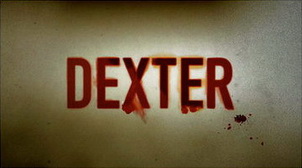
Showtime’s dark drama Dexter (don’t blame me for the alliteration – after all, the show is based on a book called “Darkly Dreaming Dexter”) is about a forensics expert who’s also a serial killer. But wait! He’s a moral serial killer who only kills bad guys, so he still qualifies to be the center of a whole television show.
I had heard this line explaining Dexter so many times from people saying the show was excellent over the last couple years, and frankly I was a bit turned off by this summary of the premise. A serial killer anti-hero seems like such a gimmick: we’ve seen
anti-heroes abound in critically acclaimed television recently – think Dr. House, Tony Soprano, Malcolm Reynolds (from Firefly), and even Jack Bauer breaking all those laws. A gimmicky serial killer show doesn’t interest me much as a concept. Who needs another crime drama? And serial killers are so Other that they’re not that psychologically interesting to me, unlike those other anti-heroes.
But I finally caved – partly because Dexter is on Instant Watch on Netflix and mostly because my sister started watching it. My sister being intrigued by a show is a good indicator that I will be, too, whether I initially like to admit it or not (see, e.g., Firefly & Doctor Who). So I watched the first episode, and then the whole first season.
Dexter, as both a show and a character, troubles me. They trouble me so much that this is a snapshot from my computer camera as I watched the second episode:

This show certainly trades in its share of blood and gore, and those who like that part of crime shows (or, say, liked the Angel of Death scene in Silence of the Lambs) will be satiated. I, on the other hand, don’t particularly like it. I’m either creeped out, or – more likely – disappointingly unmoved by fake gore because I keep thinking, “Hmm, I wonder what the techs used to mix that blood.” The sneer of disgust in the above snapshot isn’t me being grossed out by a murder scene, actually. It’s me watching the credits and thinking about the show in general. And yet I watched it, because I kept clinging to the theory that this show is more than it seems. I still think so, even though I’m not totally convinced.
(By the way, I also don’t find the show that funny, as many people on Netflix say. Yes, the sister has her moments and Dexter has some pretty dry jokes, but this isn’t a dramedy or a macabre black comedy about a serial killer (which has been done to perfection in
Keeping Mum, a delightful movie I highly recommend). It’s a cruel little show that keeps your attention with a weird twist on the anti-hero trope and a bunch of blood.)
On the one hand, Dexter as a main character seems like a clever ruse by an inept writer who was tired of hearing that his characters weren’t lifelike or human enough. Creating a “loveable monster,” which is how Dexter is billed on the books and the DVD blurb, seems an easy out. A guy who has no human emotion is supposed to be an unconvincing character, right? This is no offense to the author Jeff Linsday. I haven’t actually read the books so I don’t know if they’re any good. But it certainly seems like a cop out.
The show also seems to cop out with respect to the larger themes it engages. Other shows about unlikable characters grapple with mortality, morality, and religion by creating equally articulate but oppositely opinioned supporting characters (one of the reasons I like House so much). Dexter, on the other hand, just starts from the premise that some people deserve to die; the only grappling comes with the question, “Yeah, but does that mean it’s OK for a serial killer to kill them?”
By creating a non-human main character – less human even than anthropomorphized animals and aliens in other shows – Dexter is no longer a human we have to condone or condemn. Instead he becomes a symbol of rightful anger and bloody justice. He is an outlet for viewers, who believe in the death penalty in overwhelming numbers, who hear about killers going free on legal technicalities (and who may remember O.J. Simpson), who live vicariously through the righteous vengeance of television characters. But
vengeance isn’t ours, even in made-up books and television, and I find myself extremely reluctant to relate to Dexter or “root” for him as so many fans claim to do. The show ultimately rests the likeability of its main characters in an assumption about the inner cruelty of the viewers, and this conceit is what disturbs me the most about the series. That the show is popular seems to indicate that many people agree with this conceit, which is what disturbs me the most about the viewers of this show.
On the other hand, maybe the show and its viewers are more nuanced than that. The plots and overall arc of the first season are compelling and downright good storytelling. The multi-episode arc involving another mysterious serial killer is good (and I don't want to spoil it), even if parts of it are pretty predictable (as in, I figured out who it was the first scene he/she was in, even though there was no positive identification for several more episodes.) The actors are good, too, and some of the side stories of intra-office politics are delightfully raw and nuanced. Many of the side characters inspire empathy as well, such as a painfully honest cop who is separated from his wife because he told her about the one time he cheated on her.
Better still, even though the show revolves around a character who describes himself as neither human nor monster, Dexter does become slightly more human throughout the first series, once the premise is firmly established that he’s not. This might be because it’s impossible to create an interesting character with no emotions, but I like to think that the show is trying to break down what we think it means to be human.
If you look at it this way, the show raises questions it never discusses. In a way, this is more skillful than the shows I love (like House) that hit you with a Big Issue 2x4 whenever an interesting ethical or philosophical tension arises. And the questions raised by Dexter are both important and complex: If we fake intimacy, is it still intimate? What are the limits of anti-Kantian ethics in terms of preventing harm to others? Do we feel more compassion for Dexter because he’s a foster child with hints at a horrible past, and if we do, why? Can we really mitigate the evil of serial killing by saying, “Oh, but you had a bad childhood”? And that raises the question of the whole premise: can we really mitigate the evil of serial killing by saying, “Oh, but you killed the bad guys, at least”? Why is Dexter the serial killer our hero, but Ice Truck Killer the serial killer our villain, when they are so clearly linked? Ultimately, how can we say someone is irreversibly good or bad? And what do we do about it if we can make such a determination?
That a television show can raise so many questions, especially about what it reveals about the people who watch and like the show and the main character, reveals some hidden mastery. I’d like to think so, at least. And so who am I to judge my fellow viewers who may be thinking on this level, too, rather than simply using Dexter as an outlet for bloody justice or merely blood?
So, even though I started with that grimace, I did end up entertained by some good storytelling and intrigued by some interesting questions. All in all, 3 stars.