Gosh this seems like the story of my life some days. I really need to figure out how to get things done and not overcommit. Oh, and also just go ahead and do things I don't want to do (ahem! that phone call!) From the Prelinger Archives:


15.7.08
The Women

If you don't know anything about the movie The Women, at some point you will feel there's something off about it. Something strange; something forced. I'm not quite sure when you'll realize it, but it'll happen. You see, there are 130 speaking roles in the movie, and who knows how many people on screen. The movie is set in homes, and department stores, and spas, and other semi-public places and yet it seems that half the population has been deleted from the screen. Not a single man or boy appears on screen during the whole film.
We're used to seeing movies with mostly or only men. I don't remember any women in The Great Escape, or any in Platoon. No wait, there were some mothers in the village in Platoon. It's hard to just take women out of village scenes after all, even if they're just for show.
And that's my problem with The Women -- unlike war movies, where the lack of women is actually an issue, and represents a loss to the men, this movie just deletes men as if they don't matter. This sounds like an extreme tactic to be all about women, to be a proto-feminist movie about the issues and foibles and world of "women only." But actually, the whole movie is about the crazy competition that women have with each other in order to get men. Like a No Boys Allowed sign outside a bunch of grade school girls' secret hideout where they gossip about boys, The Women is, as its DVD case proudly proclaims, all about men. Apparently, the lives of these women revolve completely around men -- whose husband is having an affair, which rich bachelor can be hooked into being a woman's next husband after Reno, and on and on.
Now let's be fair about this: there are few movies with the star power of the Women. Made in that glorious year of Hollywood, 1939, it's got so many excellent actresses that there were problems with billing and who got to have the biggest names on screen. Apparently Norma Shearer had written into her contract that no one's name could be bigger than hers in the title credits (except for a leading man's), but damned it Joan Crawford wasn't getting at least as good. So they both got huge lettering, and Rosalind Russell had to be content with smaller letters and just stealing the show with her portrayal of the completely over-the-top gossip Sylvia Fowler. There's also Paulette Goddard (Mrs. Charlie Chaplin), Joan Fontaine (who was in Hitchcock's Rebecca) and Mary Boland (who you probably have never heard of, but she's brilliant as the worldly but silly, "in love with being in love" Countess DeLave).
And it's also a comedy of manners, sort of a female version of Oscar Wilde, spearing gossipers and the scheming ways of rich housewives (remind you of any reality TV these days?). I love these sorts of comedies, and I love those women lighting up the screen. So why didn't I like this movie?
It's not just about the No Men on Screen gimmick. It makes sense for a play, and I applaud the idea of seeing if it would work, even if it's a bit forced. But -- can I even allow my feminist self to say it? --- these women need men. Without men on screen to actually fight for or even fight over, all of the women's catty tactics towards each other just play out in a vacuum, and I could never really care about who got the guy in the end. Without men, you could never see these women be sexy and smart and winsome; they're just fighting with each other. Without men anywhere to be found, their world seems impossibly small and trivial. Where is the outside world? Where are the working classes on the streets of Manhattan (both men and women) where this movie supposedly takes place?
I often love the women in movies made around this time. The dames, the sidekicks, the gamines -- they might all exist before the glorious sexual revolution of the 1970s, but those women had it figured out. They knew how to fight to be equal with men but still be women. Think of Rosalind Russell in His Girl Friday just one year later -- a fast-talking reporter who can give and good as she gets from Cary Grant. Think of Katharine Hepburn in Woman of the Year, playing a brilliant, high-powered political columnist. Think of Barbara Stanwyck in basically anything she did. For goodness' sakes, even think of Vivian Leigh in that movie made the same year as the Women. Instead of being a smart, funny movie about smart, funny (if also conniving) women, The Women ends up just making the women small and ugly -- even if their names were big up there on the screen.
Wanted
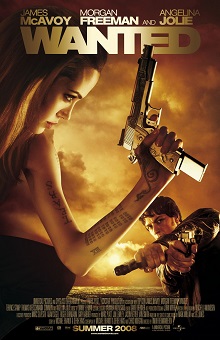
This is for John Mark.
Imagine a group of twenty-something men -- men of my generation -- in a room together talking about their favorite things. Video games, a hot chick in leather (but not too much), stuff blowing up.
Then imagine this group of men put all of their favorite things in a movie. Sound of Music, I assure you, it would not be.
Instead, you'd get what is called a summer blockbuster movie. And if one of the men in that hypothetical room vaguely remembers Greek mythology from high school, you'd get the movie Wanted. The only way to describe it is an excess -- and I do mean excess -- of all things a post-adolescent boy would consider "badass." It's got Angelina Jolie shooting things, Morgan Freeman being the wise godlike figure, and a Fight Club set-up with the main character (played by James McAvoy, who really can do better) living a zombie-like existence until he is rescued to a group of elite fighters who spend about as much screen time beating each other up as training as killing targets. Plus, most of the shots work perfectly as a video game set up. What more could a boy want? A Rocky reference or two? Oh, they are there, too (mmm . . . meat on hooks . . .). Oh, and throw in a little bit of the Matrix for good measure -- those special effects were cool, right? And everyone's mind was blown by the whole existential "There is no spoon" discussion. Might as well throw in some fate/pre-determination stuff here, too.
It is a movie that revels in excess, and this can be entertaining, but only if you've already got a high tolerance for that sort of thing. The combination of influences was a merry jumble, if somewhat overwhelming, and I must admit I enjoyed the unselfconscious stupidity of throwing all those movie and pseudo-philosophical references into a grab bag of ideas and visuals. However, if you, like me, are not used to playing Grand Theft Auto for hours on end, sitting through so many fight scenes with frenetic editing and pounding hard rock soundtrack becomes a little numbing to the senses. I'd say I liked about half of the movie and for the rest worried about an impending headache.
My friend's favorite part of the movie was when our "hero" -- I really hate calling him that -- hits someone with a keyboard. Keys fly off (as well as a tooth), and they magically align into two angry words I won't type here, but suffice it to say that the second one was "you."
This effect was clever, and somewhat funny, but I think it works a lot better in its original comic book (or is it "graphic novel"?) form. I haven't read any of the original source, but I suspect a form that uses the written word doesn't have as much trouble having to explain if the words spelled out in a picture are actually spelled out in that picture's world. When a superhero hits the villain with a POW! written in a starburst, I've never thought about where that starburst came from. But when a bullet said the word "Goodbye" in this movie, I was distracted from the moment by the nagging question, "Is that actually written there? Does it appear magically, or was it already on the bullet when it was loaded, therefore not having any specific significance in this situation?" Some parts of the comic book medium just don't work as well in a movie.
I suppose I could summarize the plot a bit, but it doesn't really matter. James McAvoy is a sadsack temp who discovers his father was part of an elite group of assassins called the Fraternity. He gets recruited, nominally to kill the man who killed his father, and quickly learns how to fight, get bloody, and curve bullets. Apparently the Fraternity has a couple of magical items in its possession. First, a magical loom's threads tell the Fraternity who should be killed (imagine the Fraternity to the be the Three Fates with guns). Second, magical paraffin wax baths serve the useful plot device of helping the assassins recover from their rough-and-tumble ways.
James McAvoy's character quickly becomes as badass as the rest of the gang, and then surpasses them in badassness when he discovers a secret of the Fraternity and decides to Do What Is Right -- which involves a lot of blowing stuff up. In fact, one of his old jackass friends, after being beaten up by him, intones in an awed voice that the friend he once took advantage of is now "the man." You can almost hear the voices of those young men writing the script bowing down to the awesomeness of the character they have just created.
Unfortunately no one has told those young writers that trying really hard to be badass doesn't actually make someone badass. You have to be a little cooler, a little more sleek, a little more aloof. I can't believe I'm about to say this, but give me Keanu and the half-baked mysticism of the Matrix any day.
1.5 stars
30.6.08
Doctor Who & Science Fiction

Recently I read a blog post about science fiction and how it's not very popular among women. one of Professor Somin's assertions caught my eye:
Casual empiricism suggests that most people with a strong interest in science fiction or fantasy literature developed that interest very as children or teenagers. I think it's very difficult to persuade an adult to take an interest in these genres if they never had previously.
Empirics aside, it must be noted that adults are not immutable in their interests. I have always avoided science fiction by and large. What little science fiction and fantasy I read comes dangerously close to being what I will call "literary fiction" -- fiction about books, history, etc. (but not historical fiction). Jasper Fforde novels are the prime example here. A couple Terry Pratchett novels are as deep I wade into science fiction. I've also always disdained of science fiction television. I pretty much can't stand any of the Star Treks, although I do like the original in small doses for its kitsch value.
So it surprises me greatly to tell you that my new TV obsession is the revived series of Doctor Who. I've thought about it quite a bit in the past couple weeks, as I've been devouring the first three seasons and part of the fourth, and I think I know why:
In the end, science fiction isn't really a description of the type of storytelling you're going to get. It's like "westerns" -- all you know is the location of the plot, not anything about it. The problem in the genre occurs when an author thinks that said location matters more than the rest of the story. When westerns are just cowboy and Indian shoot-em-ups, when science fiction devolves into monotone repetition of fanciful pseudo-science, then the genre is in real trouble. But if you dig beneath the surface, the new Doctor Who is really just an action comedy that happens to have made-up places and people. Star Trek is just a soap opera with the same (I know I'm going to get killed for saying that, but there it is -- all the episodes I've seen are so *serious*!). I like Doctor Who because though it caters to the obsessive sci-fi geeks who live for finding patterns hidden in the episodes, many of the story lines are basically just ghost stories littered with strange jokes. The quirky humor is everywhere: take even the fact that the doctor's space ship isn't some cool, sleek, "boys' toy" but rather a blue police box because the spaceship's cloaking device got stuck. There's plenty of sci-fi standbys like teleporting, but in the end the science doesn't matter as much as the plots and stories: the only two repeating "gadgets" are a blank piece of "psychic" paper and a "sonic" screwdriver.
And the use of historical plots as well as outer space plots makes the thing more like that "literary" fiction I like -- I geeked out a little bit when they visited Shakespeare and the Doctor quoted Dylan Thomas to the Bard but then told him he couldn't use it because it was "someone else's." My other favorite episode from that season (3) takes place in 1913.
So, maybe if we're all concerned about making science fiction attractive to girls as well as boys, maybe writers should take a hint from Doctor Who, which reaches about a broad an audience of British children as it can possible get. Or maybe that's just a commentary about British television and the forced ubiquity of the BBC.
22.6.08
Priceless
Another mini-review:
I came to this movie to watch Audrey Tatou, who I enjoyed so much in Amelie, and to relive Breakfast at Tiffany's, a brilliant and beautiful movie of which this is a loose adaptation. In the end, though, Ms. Tatou suffers from a script and direction that to some extent reduced her to a mannequin for all the expensive labels draped over her body. The best scenes are closeups of her, where she is actually allowed to act and remind of us her gamine quality rather than being forced to strut about in a manner very much like the women in Sex and the City. However, this movie still has wit and charm, and the minor characters are all perfect caricatures (especially the dog owners at the beginning of the movie). Most importantly, I absolutely fell in love with Gad Elmaleh, whose fumbling and awkwardness is subtle enough to reveal both charm and intelligence. I've read (but not yet seen) that he is even better in the Valet, but this was plenty good for me.
I came to this movie to watch Audrey Tatou, who I enjoyed so much in Amelie, and to relive Breakfast at Tiffany's, a brilliant and beautiful movie of which this is a loose adaptation. In the end, though, Ms. Tatou suffers from a script and direction that to some extent reduced her to a mannequin for all the expensive labels draped over her body. The best scenes are closeups of her, where she is actually allowed to act and remind of us her gamine quality rather than being forced to strut about in a manner very much like the women in Sex and the City. However, this movie still has wit and charm, and the minor characters are all perfect caricatures (especially the dog owners at the beginning of the movie). Most importantly, I absolutely fell in love with Gad Elmaleh, whose fumbling and awkwardness is subtle enough to reveal both charm and intelligence. I've read (but not yet seen) that he is even better in the Valet, but this was plenty good for me.
Spartacus: mini-review
OK, I've got lots of work still to do this weekend, but something's better than nothing, right? Here's my review from Netflix:
Spartacus is NOT your typical Kubrick in terms of lasting takeaway message -- the nihilism and despair that linger in Clockwork Orange, 2001, and Dr. Strangelove just don't exist here. It is, however, typical Kubrick insofar as it is masterful. There is not an actor in this film that I did not admire more after watching Spartacus -- they all give amazing performances, which is pretty easy, I suppose, if you have such amazing material. This would be worth a spot in your queue just to watch the famous "I am Spartacus!" scene, but it's really oh so much more. It's got layers and layers here, with certain parts of the characters' lives (I'm thinking especially Tony Curtis here) obfuscated because of the Censor Board. But that only makes it better -- you have to actually be thinking and caring about these characters to understand why they do what they do. And it's well worth the effort.
Spartacus is NOT your typical Kubrick in terms of lasting takeaway message -- the nihilism and despair that linger in Clockwork Orange, 2001, and Dr. Strangelove just don't exist here. It is, however, typical Kubrick insofar as it is masterful. There is not an actor in this film that I did not admire more after watching Spartacus -- they all give amazing performances, which is pretty easy, I suppose, if you have such amazing material. This would be worth a spot in your queue just to watch the famous "I am Spartacus!" scene, but it's really oh so much more. It's got layers and layers here, with certain parts of the characters' lives (I'm thinking especially Tony Curtis here) obfuscated because of the Censor Board. But that only makes it better -- you have to actually be thinking and caring about these characters to understand why they do what they do. And it's well worth the effort.
16.6.08
Sorry for the inconvenience
I know I've been away forever -- sorry! I've been having computer problems, and of course there were finals and vacation and starting a summer job in there, too. In any case, I've been making my way through some movies in the past few weeks, and I hope to add some new reviews soon. To give an idea of some reviews in the hopper, I'm having to take the summer to rewatch some AFI movies. As many of you know, after college I made it a point to watch every movie on the AFI 100 Years . . . 100 Movies list, which was made in 1998. Well, in 2007, the American Film Institute decided to update that list, knocking off 23 films and replacing them with 23 other films. 1/5 of the movies were incorrectly put on the list??? And only 4 films from 1997 to 2006 were added, so we're talking some serious revisions. Anyway, I'm watching those movies added to the list that I haven't already seen (and thanking my lucky stars for film class in college, without which I wouldn't have seen some of the harder-to-find films).
3.5.08
Exam Elixir
As it's study season here at school, I found this short instructional/propaganda film extremely apropos. From the goodness that is the Prelinger Archives at archive.org.
Subscribe to:
Posts (Atom)