30.6.08

Doctor Who & Science Fiction


Recently I read a blog post about science fiction and how it's not very popular among women. one of Professor Somin's assertions caught my eye:
Casual empiricism suggests that most people with a strong interest in science fiction or fantasy literature developed that interest very as children or teenagers. I think it's very difficult to persuade an adult to take an interest in these genres if they never had previously.

Empirics aside, it must be noted that adults are not immutable in their interests. I have always avoided science fiction by and large. What little science fiction and fantasy I read comes dangerously close to being what I will call "literary fiction" -- fiction about books, history, etc. (but not historical fiction). Jasper Fforde novels are the prime example here. A couple Terry Pratchett novels are as deep I wade into science fiction. I've also always disdained of science fiction television. I pretty much can't stand any of the Star Treks, although I do like the original in small doses for its kitsch value.
So it surprises me greatly to tell you that my new TV obsession is the revived series of Doctor Who. I've thought about it quite a bit in the past couple weeks, as I've been devouring the first three seasons and part of the fourth, and I think I know why:

In the end, science fiction isn't really a description of the type of storytelling you're going to get. It's like "westerns" -- all you know is the location of the plot, not anything about it. The problem in the genre occurs when an author thinks that said location matters more than the rest of the story. When westerns are just cowboy and Indian shoot-em-ups, when science fiction devolves into monotone repetition of fanciful pseudo-science, then the genre is in real trouble. But if you dig beneath the surface, the new Doctor Who is really just an action comedy that happens to have made-up places and people. Star Trek is just a soap opera with the same (I know I'm going to get killed for saying that, but there it is -- all the episodes I've seen are so *serious*!). I like Doctor Who because though it caters to the obsessive sci-fi geeks who live for finding patterns hidden in the episodes, many of the story lines are basically just ghost stories littered with strange jokes. The quirky humor is everywhere: take even the fact that the doctor's space ship isn't some cool, sleek, "boys' toy" but rather a blue police box because the spaceship's cloaking device got stuck. There's plenty of sci-fi standbys like teleporting, but in the end the science doesn't matter as much as the plots and stories: the only two repeating "gadgets" are a blank piece of "psychic" paper and a "sonic" screwdriver.
And the use of historical plots as well as outer space plots makes the thing more like that "literary" fiction I like -- I geeked out a little bit when they visited Shakespeare and the Doctor quoted Dylan Thomas to the Bard but then told him he couldn't use it because it was "someone else's." My other favorite episode from that season (3) takes place in 1913.

So, maybe if we're all concerned about making science fiction attractive to girls as well as boys, maybe writers should take a hint from Doctor Who, which reaches about a broad an audience of British children as it can possible get. Or maybe that's just a commentary about British television and the forced ubiquity of the BBC.

22.6.08

Priceless

Another mini-review:

I came to this movie to watch Audrey Tatou, who I enjoyed so much in Amelie, and to relive Breakfast at Tiffany's, a brilliant and beautiful movie of which this is a loose adaptation. In the end, though, Ms. Tatou suffers from a script and direction that to some extent reduced her to a mannequin for all the expensive labels draped over her body. The best scenes are closeups of her, where she is actually allowed to act and remind of us her gamine quality rather than being forced to strut about in a manner very much like the women in Sex and the City. However, this movie still has wit and charm, and the minor characters are all perfect caricatures (especially the dog owners at the beginning of the movie). Most importantly, I absolutely fell in love with Gad Elmaleh, whose fumbling and awkwardness is subtle enough to reveal both charm and intelligence. I've read (but not yet seen) that he is even better in the Valet, but this was plenty good for me.

Spartacus: mini-review

OK, I've got lots of work still to do this weekend, but something's better than nothing, right? Here's my review from Netflix:

Spartacus is NOT your typical Kubrick in terms of lasting takeaway message -- the nihilism and despair that linger in Clockwork Orange, 2001, and Dr. Strangelove just don't exist here. It is, however, typical Kubrick insofar as it is masterful. There is not an actor in this film that I did not admire more after watching Spartacus -- they all give amazing performances, which is pretty easy, I suppose, if you have such amazing material. This would be worth a spot in your queue just to watch the famous "I am Spartacus!" scene, but it's really oh so much more. It's got layers and layers here, with certain parts of the characters' lives (I'm thinking especially Tony Curtis here) obfuscated because of the Censor Board. But that only makes it better -- you have to actually be thinking and caring about these characters to understand why they do what they do. And it's well worth the effort.

16.6.08

Sorry for the inconvenience

I know I've been away forever -- sorry! I've been having computer problems, and of course there were finals and vacation and starting a summer job in there, too. In any case, I've been making my way through some movies in the past few weeks, and I hope to add some new reviews soon. To give an idea of some reviews in the hopper, I'm having to take the summer to rewatch some AFI movies. As many of you know, after college I made it a point to watch every movie on the AFI 100 Years . . . 100 Movies list, which was made in 1998. Well, in 2007, the American Film Institute decided to update that list, knocking off 23 films and replacing them with 23 other films. 1/5 of the movies were incorrectly put on the list??? And only 4 films from 1997 to 2006 were added, so we're talking some serious revisions. Anyway, I'm watching those movies added to the list that I haven't already seen (and thanking my lucky stars for film class in college, without which I wouldn't have seen some of the harder-to-find films).

3.5.08

Exam Elixir

As it's study season here at school, I found this short instructional/propaganda film extremely apropos. From the goodness that is the Prelinger Archives at archive.org.

28.4.08

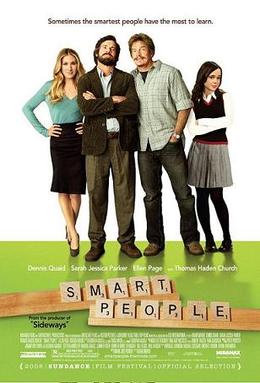
Smart People


Smart People fits into the mass-audience pseudo-indie film category that some of the most popular movies of the past few years (Juno, Napoleon Dynamite) come from. But with over-exposure comes being over-done. This is a passably enjoyable film, exhibiting both the best and the worst of the genre.
On one hand, all the actors (except SJP, who mostly just looks like she's mixing Family Stone with SATC and hoping that'll pass as acting) inhabit their characters incredibly, revealing their fear and vulnerability under the hard exteriors that come with being "smart" and "successful." I really loved the poignancy of Ellen Page's character -- a high school girl whose desire to live up to her father has sapped her of her childhood. Dennis Quaid, as lonely, over-compensating misanthropic professor, is also amazing.
Unfortunately, the great performing suffered from a script at times too obvious ("We're smart people; we'll figure it out" is a bit of a 2x4, no?) and direction too blatant (a brilliant bit with Thomas Haden Church's character posting signs on telephone poles is almost ruined by calling too much attention to the gag). And, the story has too many haphazard events unnecessary to the resolution of the film (I'm thinking mostly of the son's girlfriend, the recommendation letter, and the pregnancy).
In the end, though I enjoyed it, I wish the movie had lived up to its name and been a little more, well, smart.

2.5 stars.

17.4.08

Play Misty For Me


Clint Eastwood is my mother's favorite actor, and so, in honor of the approaching holiday in her honor, I watched Clint's directorial debut. (OK, well, I didn't really watch it for that reason, but I did watch it in large part because I grew up with my mother gushing over the man.) I must confess horror movies don't generally do it for me. With the exception of Hitchcock and his disciples, I can never really get into them. I don't particularly like gore -- it either grosses me out, or just as often looks way too fake for me to do anything other than stare at it with an amateur director/critic's eye and just be unimpressed. And the whole idea of being scared or "thrilled" rarely works differently -- the only movie that has come even close to freaking me out since I was 16 and started watching R rated movies was The Shining. Everything else just seems too contrived for me. It's so formulaic that there's no horror involved -- you know exactly who's going to die or get hurt and when, and that just takes all the fun out of it. It's not like romcom, where the formula supports the genre; horror is supposed to surprise and startle you, but if it's so obviously working off something as predictable as sewing patter, well, I'm not sold.

So maybe I'm not the best person to review this piece with a favorable eye, but while I thought the movie was decent, my main comment is that Play Misty For Me has become a period piece -- everything about it is steeped in the early 70s, which is fun to watch but even more distracting to the idea of a thriller. Even the suspense seems dated: a quaint idea based on the premise that someone would meet a woman, slowly realize she is suicidal and has psychotic episodes, and then proceed to do nothing about it until all sorts of havoc has been wreaked. However, if you can get over the things that date this movie, it's quite enjoyable: the actors are all young and passionate (I mean that in all senses of the word) and the plot makes for a simple vehicle for them to chew scenery and revel in 1970s California, which is shot quite beautifully (red woods, ocean, and cliffs abound). The direction is sometimes predictable (lots of shots that seem omniscient and then you realize they are point of view shots, for example), but it is worthy enough to foreshadow the much better work that Clint directed later, from Unforgiven to Mystic River to Million Dollar Baby.

1.4.08

The Aviator


Confession: I am not a Martin Scorsese fan. Raging Bull was fine, but I definitely wouldn't rate it as the fourth best American movie ever. But eventually the perpetual hype got to me, and I put The Aviator in my DVD player with great anticipation. A three-hour long movie (170 minutes, to be exact) that got rave reviews has to be riveting, right?

Unfortunately, the other option for a 170 minute movie is that it's overblown with its own importance. Granted, it fits well with the subject matter here -- it appears that Howard Hughes was a pretty self-important man -- but Mr. Scorsese seems to forget that a movie is still a movie no matter how long, and it would have been nice to feel like there was a reason for my watching rather than seeing a scattershot of events that happen to be roughly true.

For those of you who may have missed it, The Aviator outlines the life of Howard Hughes, the great filmmaker and aviator, from the late 1920s to the 1940s. (Howard Hughes produced Hell's Angels, Scarface, The Outlaw, and a slew of films noir in the '50s, and set multiple air-speed records during his lifetime.) I'm not quite sure why the timeframe of the movie was chosen -- after a brief prologue of a scene of Hughes as a child, it jumps straight to the production of Hell's Angels, which wasn't Hughes' first movie. And it stops after he successfully tests the Hercules, a huge aircraft that spent him years to make, but before he took control of RKO, or severed his relationship with his longtime assistant Noah Dietrich, or founded the Howard Hughes Medical Institute. Maybe this would make sense if we assume that everyone knows about Howard Hughes's story and his descent into madness in his later years, but let's not assume that a movie-going public that is mostly teenagers knows about a rich and crazy guy who died in the 70s.

As for the movie itself, the best part about the movie was that it was star-studded as Howard Hughes' apparently was: big names played bit parts for the chance to be in a Scorsese film, and it was fun to watch Gwen Stephani, Jude Law, Ian Holmes, Alan Alda, and a bunch of others in fairly small roles. Leonardo DiCaprio does a good job playing a part with almost no guidance from the script as to a story arc. Now, I know people's lives don't necessarily have climaxes and turning points and drama to their days, but if you're consolidating a life (or part of a life) to a few hours, you've got to have a reason for what you see and what you dont. Now, I don't mean that I need to know why Hughes went mad, for example, but hinting that it was a childhood thing but not exploring that just frustrated me, and to have character after character march in and out of his life isn't helpful to understanding his life. Similarly, Cate Blanchett does a passable job as Katharine Hepburn, but her role seemed more about imitation than acting -- the problem with playing a person that spent a lot of the time on film herself. In the end, I felt like the movie was less a story than an observation/impersonation, which seems a waste of time and talent to me. Even documentaries are supposed to be edited to have a direction to the story it tells, but this was just sprawling and pointless even though it was larger-than-life and impressive to watch. Maybe that was the point: that Howard Hughes' life was jam-packed with action, danger, risky business moves, Hollywood stars, and paranoia, but in the end didn't have much direction or purpose. But if that was the point, I'd rather read a biography that really explores the whole life and wonders why his life was both so amazing and so screwed up. Just watching some random, disparate parts of a man's life for three hours was about double the time I was willing to spend. Note to future Scorseses: Editing something to make it shorter generally makes it better, not worse.

2 stars